

Ever wondered what happens inside a black hole? The universe holds no greater mystery than what lies beyond the point of no return—the event horizon. Since Einstein first predicted their existence in 1915, and astronomers confirmed them decades later, black holes have haunted our cosmic imagination.
In 2022, scientists captured the first direct image of Sagittarius A*, the supermassive black hole at the center of our Milky Way galaxy. This brought these invisible titans into sharp focus. The question that keeps physicists awake at night remains: what happens in black hole interiors?
The answer turns out to be far stranger than science fiction ever imagined. From the violent stretching of spaghettification to the mind-bending warping of time itself, crossing the threshold transforms everything. Here’s what science tells us about one of the universe’s most extreme environments.
Understanding Black Holes: More Than Just Darkness
Before we can understand what happens in black hole interiors, we need to grasp what these cosmic monsters actually are. Black holes are regions of spacetime where gravity has become so intense that nothing—not even light—can escape once it crosses a boundary called the event horizon.
They form when massive stars collapse at the end of their lives. When a star at least 20 times more massive than our Sun exhausts its nuclear fuel, it can no longer support itself against its own gravity. The core implodes in a fraction of a second. If enough mass compresses into a small enough space, the result is one of nature’s most extreme objects.
The Nature of Extreme Gravity
The defining feature isn’t actually darkness—it’s extreme gravitational pull. According to Einstein’s general theory of relativity, massive objects warp the fabric of spacetime around them. Imagine a bowling ball placed on a stretched rubber sheet. These cosmic giants represent the ultimate extreme of this warping, creating a gravitational well so deep that spacetime essentially tears.
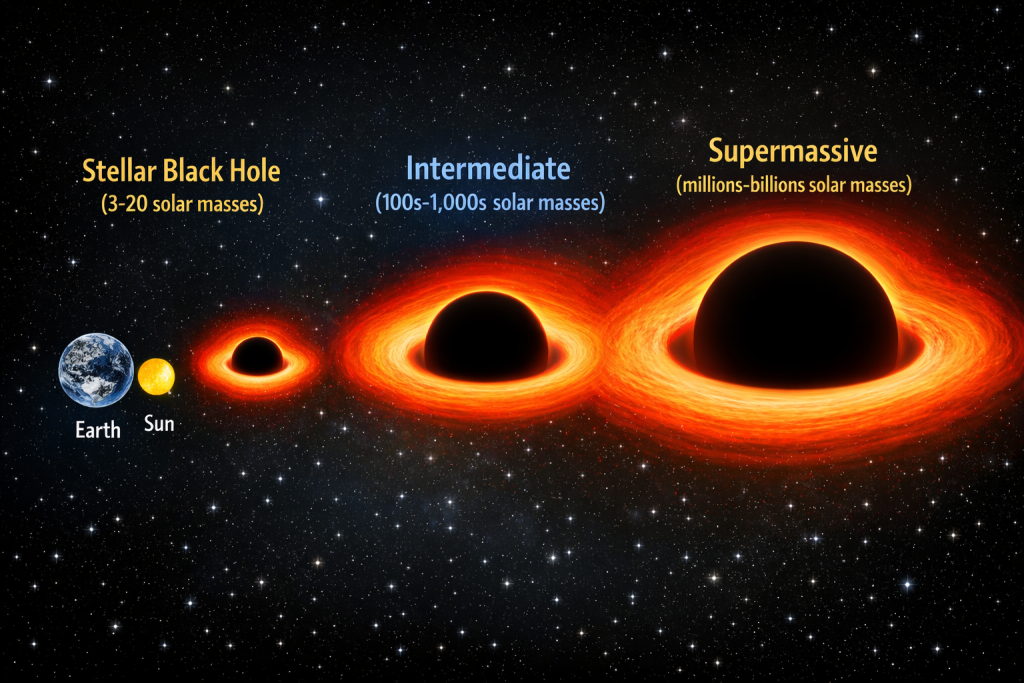
Scientists currently recognize three main types based on their mass. Stellar ones, formed from collapsed stars, typically contain between 3 and 20 solar masses. Intermediate ones, which remain somewhat mysterious, range from hundreds to thousands of solar masses. Supermassive versions, found at the centers of most galaxies including our own, contain millions or even billions of solar masses.
Our Galactic Center
Sagittarius A*, our galaxy’s central supermassive object, weighs approximately 4 million times the mass of the Sun. Interestingly, these aren’t actually “holes” in space. They’re incredibly dense objects with all their mass concentrated at a point called the singularity.
The event horizon is simply the boundary around this singularity where escape velocity equals the speed of light. Once you cross it, all paths lead inexorably inward. You couldn’t move in any other direction. The singularity isn’t a place in space that you could theoretically avoid by moving sideways—it’s a moment in your future that you will unavoidably reach.
The Approach: When Time Itself Goes Strange
Long before you’d reach the event horizon, you’d notice something profoundly unsettling. Time itself would begin to behave strangely. As you approached, observers watching from a safe distance would see you moving slower and slower. Your image would become increasingly redshifted as the intense gravity stretched the wavelengths of light leaving your body.
From your perspective, however, time would seem to pass normally. This phenomenon, called gravitational time dilation, occurs because gravity warps not just space but spacetime itself.
Time Dilation Effects
The stronger the gravitational field, the slower time passes relative to areas with weaker gravity. Near the event horizon, this effect becomes extreme. If you could somehow hover just outside the event horizon of a supermassive object for what felt like one hour to you, thousands or even millions of years might pass in the outside universe.
This depends on how close you were to the point of no return. This isn’t science fiction—it’s a prediction of Einstein’s equations. Countless experiments and observations have confirmed this reality.
The Beginning of Tidal Forces
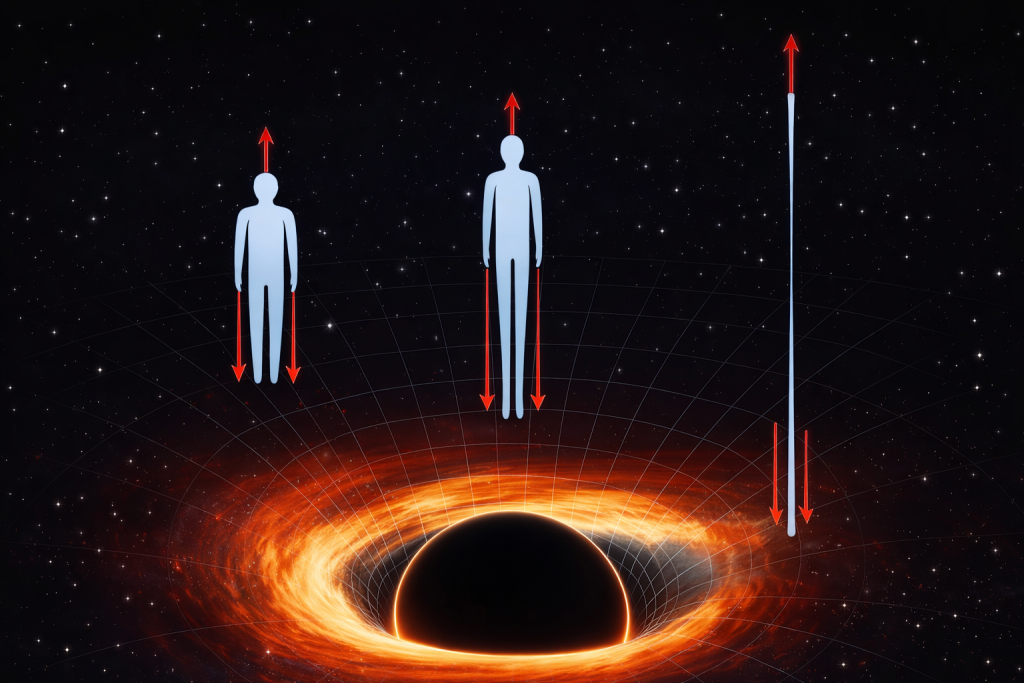
As you fell closer, you’d also experience tremendous tidal forces. The gravitational pull on the side of your body nearest the center would be significantly stronger than the pull on your far side. This difference in gravitational force across your body is called a tidal force. It’s similar to how the Moon creates ocean tides on Earth, but incomprehensibly more intense.
Spaghettification: The Cosmic Stretching Process
For stellar versions—the smallest type—these tidal forces would become lethal long before you reached the event horizon. Your body would be stretched vertically and compressed horizontally. Physicists cheerfully call this process “spaghettification.”
The Violent Reality
Your molecules would be pulled apart atom by atom. Then your atoms would be ripped into their constituent particles. All of this would be stretched into a thin stream of matter spiraling inward. The process would be instantaneous and utterly destructive.
However, supermassive versions present a different scenario. Because they’re so enormous, their event horizons are much farther from their singularities. The tidal forces at the event horizon are actually quite gentle.
A Different Experience at Different Scales
Theoretically, you could cross the event horizon of a supermassive object like Sagittarius A* without immediately being torn apart. You might not even notice the exact moment you passed through the point of no return. This counterintuitive reality demonstrates how size dramatically affects the experience of crossing this cosmic boundary.
Crossing the Point of No Return
The event horizon represents one of the most profound boundaries in physics—a one-way membrane in spacetime. Once you cross it, every direction you could possibly move leads toward the singularity at the center. Even if you pointed your rocket engines directly away from the singularity and fired them at full thrust, you would still inexorably fall inward.
The Warping of Spacetime Itself
This seems to violate common sense. But it’s a consequence of how severely spacetime is warped. Inside the event horizon, the future direction of time itself points toward the singularity. Trying to avoid the singularity once you’ve crossed would be like trying to avoid next Tuesday.
It’s not a question of going in a different direction. It would require traveling backward in time, which even these extreme conditions don’t allow.
The External Observer’s Paradox
According to general relativity, the moment you cross, reaching the singularity becomes as inevitable as the passage of time. From the outside universe’s perspective, something equally strange would occur. Due to extreme time dilation, anyone watching you approach would never actually see you cross it.
Your image would appear to slow down asymptotically. It would become increasingly redshifted and dimmer, effectively freezing just outside for eternity. In a sense, from the outside universe’s viewpoint, you would remain suspended forever. Yet from your perspective, you’d smoothly pass through in finite time.
This creates what physicists call the “information paradox.” If you and all the information you carry appear to remain at the event horizon forever from an external perspective, but you experience falling through and being destroyed, what actually happens to that information? This question sits at the heart of one of physics’ deepest unsolved mysteries.
Inside: The Final Descent Into Chaos
After crossing the event horizon of a supermassive object, you might have minutes or even hours before reaching the singularity. This depends on the size. During this time, you’d experience increasingly bizarre phenomena.
The Return of Destructive Forces
The tidal forces that were gentle at the event horizon would grow stronger as you approached the singularity. Eventually, even in a supermassive version, spaghettification would become unavoidable. The differential forces would stretch your body into a long, thin filament. This would destroy your molecular structure in the process.
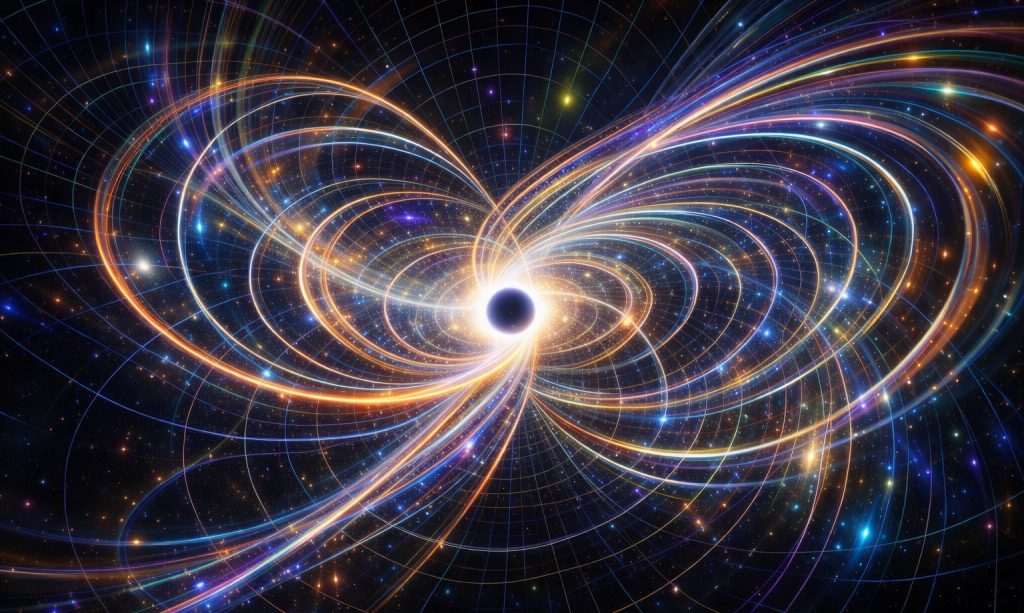
But before that final destruction, you might witness something extraordinary. Some theoretical models suggest that the interior could be incredibly bright. It might be filled with all the light that has ever crossed the event horizon, trapped and circling the singularity.
A Photon Sphere of Trapped Light
This photon sphere would create a bizarre illumination unlike anything in the external universe. You might also experience extreme distortions in your perception of space and time. Inside the event horizon, the roles of space and time become interchanged in a mathematically precise way.
The radial direction toward the singularity becomes timelike, while time becomes spacelike. Some theoretical physicists have proposed that the interior of rotating versions might contain pathways to other regions of spacetime. They might even lead to other universes.
Theoretical Pathways and Mathematical Solutions
These ideas emerge from mathematical solutions to Einstein’s equations, particularly the Kerr solution for rotating objects. This solution suggests the possibility of avoiding the singularity by passing through an inner event horizon. However, most physicists believe these mathematical solutions don’t represent physical reality. Any such structures would be unstable and collapse before anything could traverse them.
The Singularity: Where All Physics Breaks Down
At the center lies the singularity—a point of infinite density where the known laws of physics cease to function. According to general relativity, all the mass is compressed into this zero-dimensional point. This creates infinite curvature of spacetime.
The Limits of Current Theory
However, most physicists believe this prediction of infinite density indicates that general relativity is incomplete. It doesn’t describe actual physical reality. When physicists encounter infinities in their equations, it typically signals that the theory breaks down. A more fundamental theory is needed.
This is where quantum mechanics enters the picture. General relativity brilliantly describes gravity and spacetime on large scales. But it doesn’t account for quantum effects. Quantum mechanics, meanwhile, accurately describes the behavior of particles and forces at tiny scales. But it doesn’t incorporate gravity.
The Need for Quantum Gravity
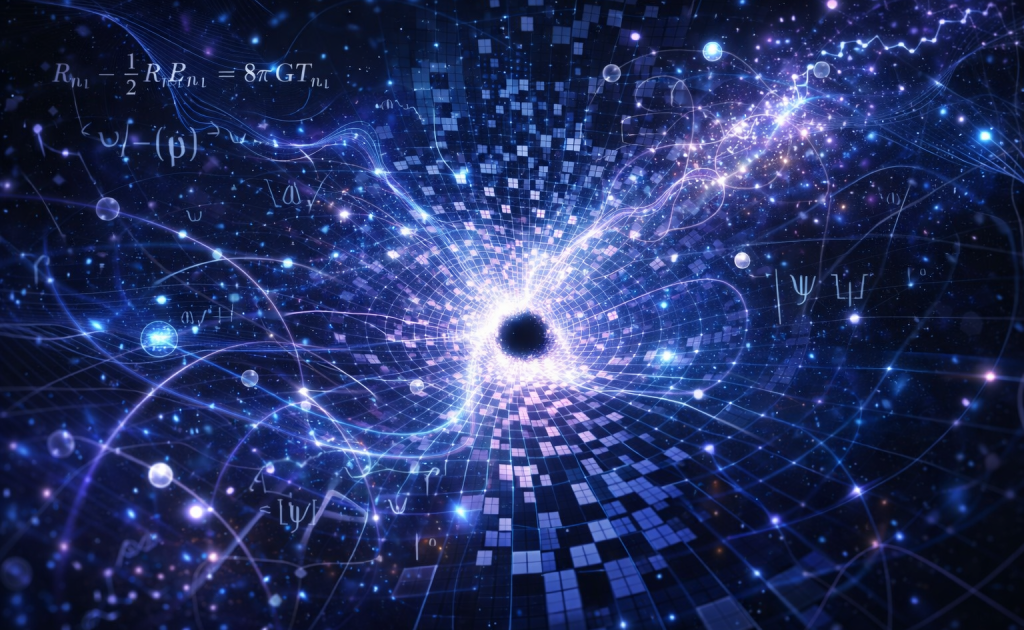
At the singularity, both quantum effects and extreme gravity become important simultaneously. This requires a theory of quantum gravity that we don’t yet possess. Several candidate theories attempt to describe what really happens at the singularity.
String theory suggests that what appears as a point singularity might actually be a small but finite region. The fabric of spacetime might have a complex, multidimensional structure there. Loop quantum gravity proposes that spacetime itself is quantized at the smallest scales.
Nobel Prize-Winning Work
The 2020 Nobel Prize in Physics was awarded partly to Roger Penrose for proving that singularities are a generic feature of general relativity. They’re not just special cases. His singularity theorems demonstrate that under very general conditions, gravitational collapse must produce singularities. This mathematical certainty makes the question of what actually happens at a singularity even more pressing.
Some recent theoretical work suggests that quantum effects might prevent the formation of a true singularity. Instead, they might create what’s called a “Planck star”—an incredibly dense but finite object. If this is correct, the core might eventually bounce back, potentially creating a “white hole” that expels matter into another region of spacetime.
The Information Paradox: A Crisis in Physics
One of the most profound mysteries about what happens in black hole interiors concerns information itself. In quantum mechanics, information about the quantum state of particles cannot be destroyed. It’s a fundamental principle called unitarity. However, these objects seem to violate this principle.
The Loss of Information
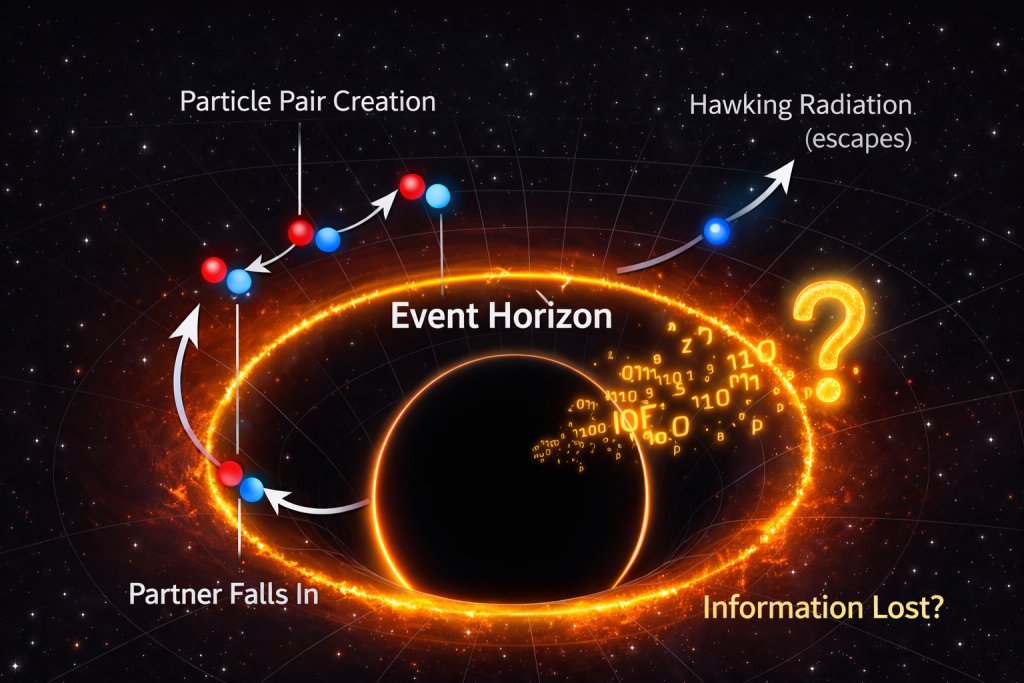
When matter falls in, it appears that all information about that matter’s quantum state is lost forever once it crosses the event horizon. This creates a conflict between quantum mechanics and general relativity known as the information paradox. Stephen Hawking first identified this in the 1970s.
The paradox deepened when Hawking discovered that these objects aren’t entirely black. Due to quantum effects near the event horizon, they emit thermal radiation. This is now called Hawking radiation.
Hawking Radiation and Evaporation
Over incredibly long timescales, this radiation would cause complete evaporation. But Hawking radiation appears to be thermal—essentially random. It carries no information about what fell in. If complete evaporation occurs, taking with it all the information about the matter consumed, this would fundamentally violate quantum mechanics.
Alternatively, if the information somehow escapes, it would seem to require faster-than-light communication from inside the event horizon. This would violate relativity.
Proposed Solutions
This paradox has driven much of theoretical physics research for the past five decades. Recent work suggests that information might be encoded in subtle correlations in the Hawking radiation. It might be preserved in the quantum entanglement between particles inside and outside the event horizon.
Or it could be stored in a “firewall” at the event horizon itself—though each proposed solution creates new problems. In 2019, Hawking’s final scientific paper, published posthumously, proposed that information might be preserved in “soft hair.” These are low-energy quantum excitations on the event horizon.
Holographic Principles
Other physicists have suggested that the information paradox might be resolved through holography. This is the idea that all the information about the three-dimensional interior is encoded on its two-dimensional event horizon, similar to how a hologram works.
The resolution likely requires a complete theory of quantum gravity. This remains one of the greatest unsolved problems in physics. Understanding what truly happens inside—and to the information consumed—may ultimately reveal the deepest nature of reality itself.
What Real Observations Have Taught Us
While we can’t directly observe what happens in black hole interiors, recent astronomical achievements have revolutionized our understanding of these cosmic giants. The Event Horizon Telescope, a planet-sized array of radio telescopes, captured the first direct image of an event horizon in 2019.
The M87* Image
It showed the supermassive object M87* at the center of galaxy M87, located 55 million light-years away. This historic image revealed a dark shadow surrounded by a bright ring of emission—exactly as general relativity predicted. The shadow’s size and shape matched Einstein’s equations with remarkable precision.
This provided the strongest confirmation yet that these objects truly exist as described by general relativity. They’re not some alternative exotic object.
Sagittarius A* Revealed
In 2022, the Event Horizon Telescope collaboration released the first image of Sagittarius A*. Despite being more than 1,000 times closer than M87*, it proved more challenging to image. Matter orbits it much faster, changing the scene on timescales of minutes rather than weeks.
These observations have also taught us about the extreme environments surrounding these objects. The matter falling in forms an accretion disk—a swirling vortex of superheated gas and dust.
Accretion Disks and Jets
Friction within this disk heats the material to millions of degrees. This causes it to emit intense X-rays and other radiation. Some of the most energetic phenomena in the universe occur in these accretion disks.
These objects also produce powerful jets—narrow beams of particles and radiation that shoot out from near the poles at nearly the speed of light. These jets can extend for hundreds of thousands of light-years, far beyond their host galaxies. The exact mechanism that launches these jets remains debated. But it involves rotation and intense magnetic fields in the accretion disk.
Gravitational Waves: A New Window
Gravitational wave detectors like LIGO and Virgo have opened another window into behavior. Since 2015, these instruments have detected dozens of mergers. These are cataclysmic events where two of these objects spiral together and combine.
Merger Discoveries
The process releases tremendous energy in the form of gravitational waves. These observations have revealed a population with masses that surprised many astronomers. They have provided unprecedented tests of general relativity in its most extreme regime.
Each detection confirms predictions made by Einstein over a century ago. The observations also reveal the violent processes that occur when these cosmic giants collide.
The Future of Black Hole Research
Our understanding of what happens in black hole environments continues to evolve. Several upcoming missions and theoretical developments promise to deepen our knowledge in the coming years.
Upcoming Space Missions
The Nancy Grace Roman Space Telescope, scheduled to launch in the mid-2020s, will survey our galaxy to find and study stellar-mass versions through gravitational microlensing. This could reveal whether small ones make up some of the mysterious dark matter that permeates the universe.
Next-generation gravitational wave detectors, including the space-based LISA mission planned for the 2030s, will detect mergers that current instruments miss. This includes mergers of supermassive versions that occur when galaxies collide.
Theoretical Advances
These observations will help us understand how the most massive ones in the universe form and grow. On the theoretical front, advances in quantum gravity research may finally resolve the information paradox. They may reveal what truly happens at the singularity.
Approaches like string theory, loop quantum gravity, and causal set theory all offer different perspectives on the quantum nature of these objects. The interplay between theory and observation continues to drive progress.
Testing General Relativity
Each new observation tests our theoretical models. Sometimes it confirms predictions and sometimes reveals surprises that demand new explanations. The recent images of shadows, for instance, have allowed physicists to test whether alternatives to general relativity might better explain these extreme objects.
So far, Einstein’s century-old theory continues to pass every test. However, scientists remain open to the possibility that new observations might reveal limits to our current understanding.
The Strange Reality We’ve Uncovered
The journey into what happens in black hole environments would involve experiencing spaghettification, extreme time dilation, and ultimately reaching a singularity. Our current physics cannot fully describe what occurs at this final point. The information paradox suggests that complete understanding may require reconciling quantum mechanics and general relativity.
Confirmed Predictions
Recent observations have confirmed that real versions behave as general relativity predicts, at least from the outside. The Event Horizon Telescope images and gravitational wave detections have transformed them from theoretical curiosities into observable astrophysical objects. We can now study them in unprecedented detail.
What truly happens at the singularity remains unknown. Whether information is preserved or destroyed is still debated. How quantum effects modify the classical picture all remain active areas of research.
The Frontier of Knowledge
The answers to these questions may ultimately reveal fundamental truths about the nature of space, time, and reality itself. These cosmic giants stand at the frontier of human knowledge. They challenge our understanding of physics and push the boundaries of what we can know about the universe.
As our observational capabilities improve and our theoretical tools advance, we continue to peer deeper into these cosmic enigmas. We’re seeking to understand one of nature’s most mysterious creations. In doing so, we may unlock the deepest secrets of existence itself.
The journey to understand what happens in black hole interiors continues to captivate scientists and the public alike. Each new discovery brings us closer to answering fundamental questions about the universe and our place within it.
Discover more from Factopiax
Subscribe to get the latest posts sent to your email.