
Have you ever wondered why do cats purr? You’re curled up on the couch, and your cat jumps into your lap. Within seconds, you hear it—that unmistakable rumbling sound.
It’s like a tiny motor running inside your feline friend. Your cat is purring, and it feels like pure contentment. But have you ever wondered why do cats purr? What’s actually happening inside your cat’s body to create that soothing vibration? And more importantly, what does all that purring really mean?
The answer is far more fascinating than you might expect. Scientists have studied cat purring for decades. While we’ve learned a lot, this common feline behavior still holds some surprising secrets.
From healing bones to communicating complex emotions, purring is one of nature’s most remarkable adaptations. Let’s dive into the science behind why cats purr and discover what that rumbling really means.
Table of contents
- The Purr That Connects Us: Understanding Your Cat’s Most Mysterious Sound
- The Contentment Signal: When Cats Purr Because They’re Happy
- The Healing Purr: Can Cat Purrs Actually Heal Bones?
- Stress, Pain, and Fear: Why Do Cats Purr When They’re Not Happy
- The Solicitation Purr: When Your Cat Wants Something
- Purring as Communication: What Your Cat Is Really Saying
- The Evolution of Purring: Why Did Cats Develop This Ability?
- Do All Cats Purr the Same Way?
- Health Benefits of Cat Purring for Humans
- When Purring Might Indicate a Problem
- The Purr That Connects Us: Understanding Your Cat’s Most Mysterious Sound
- FAQ: Common Questions About Cat Purring
The Purr That Connects Us: Understanding Your Cat’s Most Mysterious Sound
Before we explore why cats purr, let’s understand how they do it. The physical mechanism behind purring is surprisingly complex.
Where Purring Originates
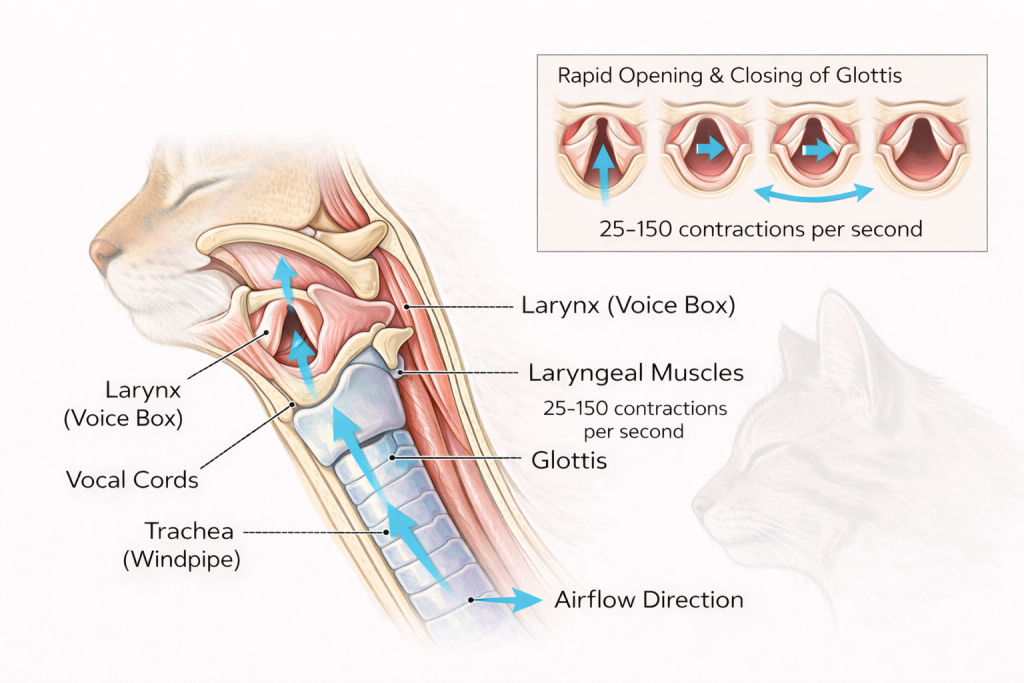
Purring starts in your cat’s larynx (voice box) and the surrounding muscles. As your cat breathes in and out, the laryngeal muscles rapidly contract and relax.
This happens approximately 25 to 150 times per second. These rapid movements create a rhythmic opening and closing of the glottis. The glottis is the space between the vocal cords.
When air passes through this rapidly moving space, it creates vibrations. These vibrations produce the characteristic purring sound.
The Continuous Nature of Purring
What’s remarkable is that cats can purr continuously for minutes or even hours. Your feline friend maintains that steady rumble while breathing normally.
Try humming continuously while breathing. It’s nearly impossible for humans. Yet cats do it effortlessly.
The vibrations don’t just stay in the throat. Instead, they travel throughout your cat’s entire body. That’s why you can feel that gentle tremor when you hold a purring cat.
The Frequency Range
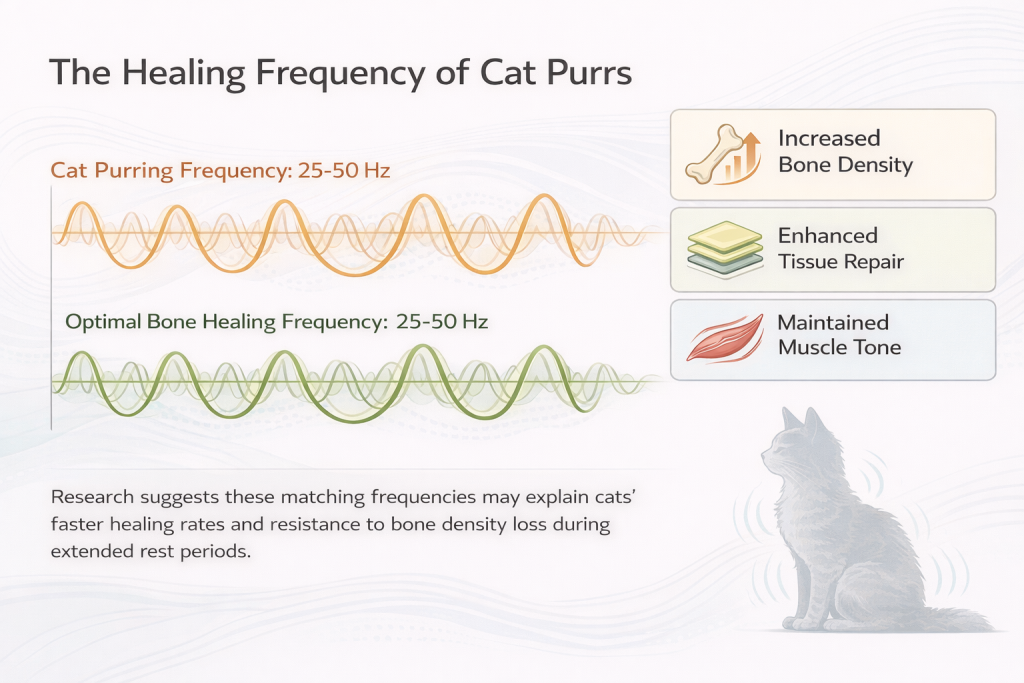
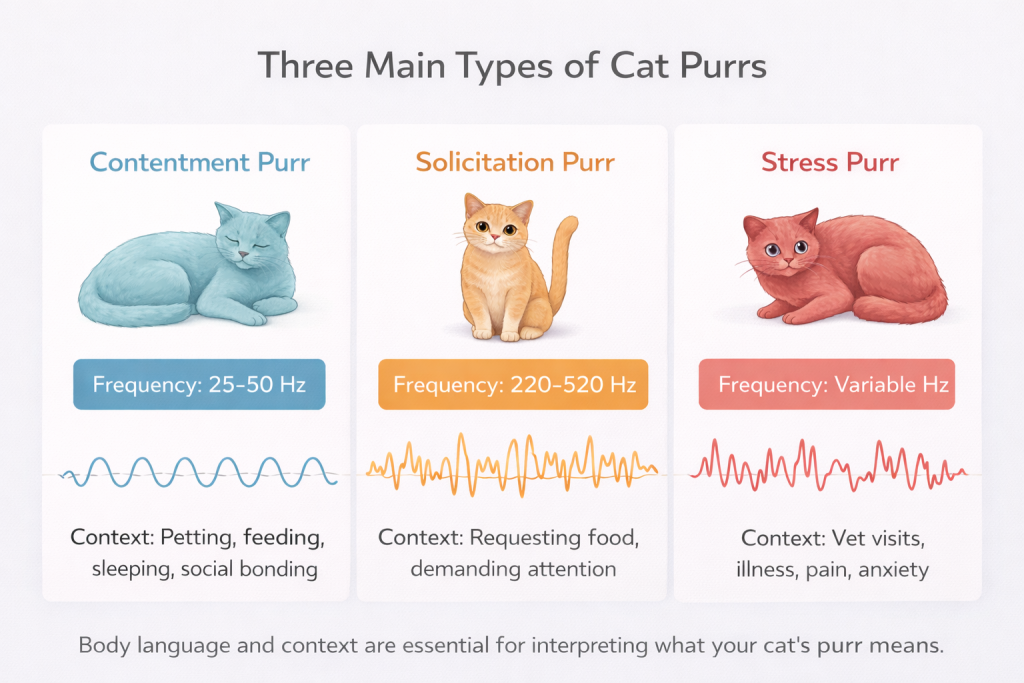
The frequency of most cat purrs falls between 25 and 50 hertz. However, it can vary by individual cat and situation.
This specific frequency range turns out to be significant. We’ll explore why later in this article.
Not All Cats Can Purr
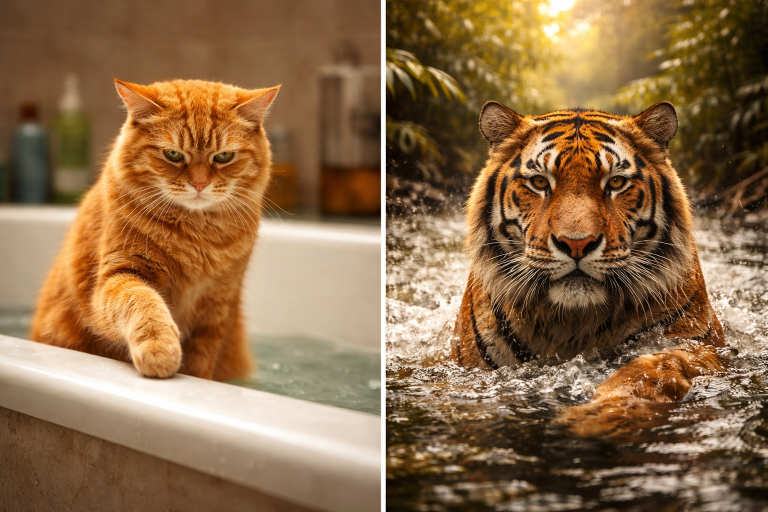
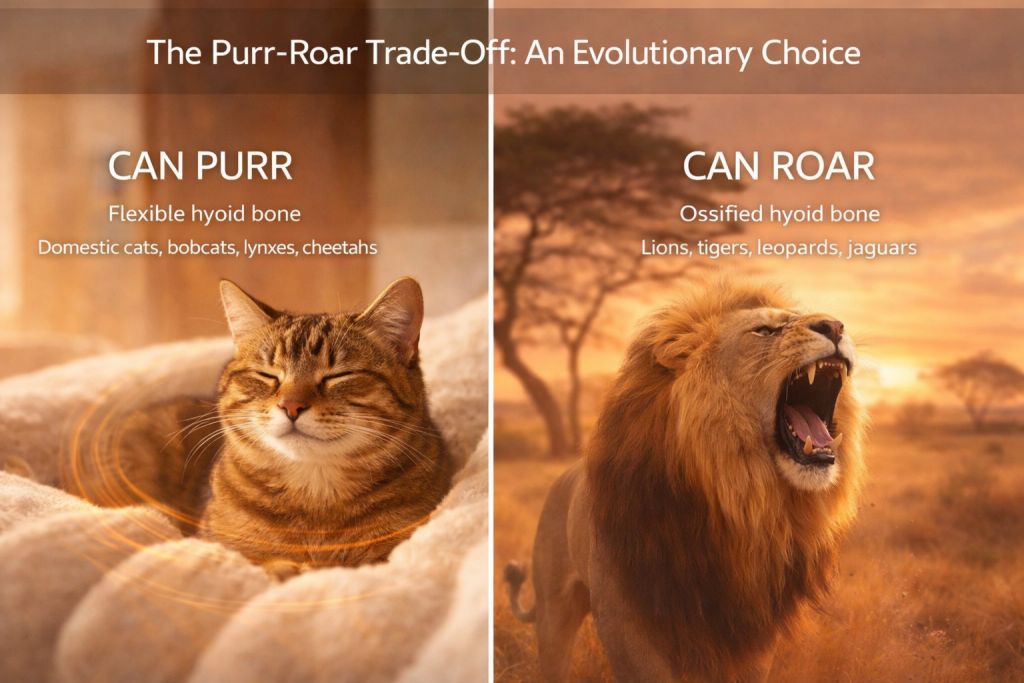
Interestingly, not all cats can purr. Big cats like lions, tigers, and leopards cannot produce a true purr.
Differences in their laryngeal anatomy explain this limitation. Instead, these large felines can roar—a trade-off in vocal abilities.
Smaller wild cats can purr. Bobcats, lynxes, and cougars all have this ability. All domestic cats can purr as well.
This suggests purring evolved as a specific adaptation in certain feline species. Understanding this vocalization starts with understanding how they create this unique sound. The mechanics reveal just how specialized this vocalization truly is.
The Contentment Signal: When Cats Purr Because They’re Happy
The most common reason cats purr is exactly what you’d expect. Your feline companion is content and relaxed.
Purring During Positive Interactions
When your cat settles into your lap, purring often begins. This happens especially when they’re kneading with their paws.
Cats are expressing genuine pleasure and comfort. This type of purring typically happens during positive social interactions. This is the most common reason for this behavior—simple happiness and relaxation, whether with their mother as kittens or with their trusted humans as adults.
Mother cats purr while nursing their kittens. This creates a soothing environment. It also helps kittens locate them, since kittens are born blind and deaf.
Kittens Learn to Purr Early
Kittens start purring when they’re just a few days old. Newborn felines use it to communicate with their mother.
The purr tells the mother they’re feeding successfully. It also signals they’re feeling safe.
Adult cats continue this behavior throughout their lives. Felines purr when being petted or settling down to sleep. They purr when eating food they enjoy or greeting their favorite humans.
What Contentment Purring Looks Like
This “happiness purr” is usually steady and moderate in volume. Relaxed body language accompanies it.
You’ll see half-closed eyes, a gently swishing tail, and a loose posture. Your cat looks completely comfortable.
The Social Function of Purring
Scientists believe contentment purring serves important social functions. In the wild, cats are typically solitary hunters.
However, they do form social bonds. These occur particularly between mothers and offspring. Sometimes adult cats in colonies bond as well.
Purring provides a non-threatening way to communicate peaceful intentions. It strengthens social bonds without requiring eye contact or physical touch.
Purring With Humans
For domestic cats, purring has become crucial to their relationship with humans. Your cat has learned that purring elicits positive responses.
You give attention, petting, treats, or continued comfort. It’s a communication tool that says, “I’m happy here, please keep doing what you’re doing.”
However, contentment is far from the only reason they purr. Some of the other motivations are quite surprising.
The Healing Purr: Can Cat Purrs Actually Heal Bones?
Here’s where the science of purring gets truly fascinating. The specific frequency of cat purrs may have genuine therapeutic benefits.
The Frequency Connection
Research suggests that vibrations at frequencies between 25 and 50 hertz promote bone density. These same vibrations also stimulate healing.
This frequency range matches the dominant frequency of cat purrs. It’s not a coincidence—it’s likely an evolutionary adaptation.
Why Cats Need This Adaptation
Cats spend a lot of time resting and sleeping. Adult cats rest up to 16 hours a day.
Unlike animals that remain constantly active, this lifestyle could lead to problems. You’d expect to see bone density loss and muscle atrophy.
Astronauts experience similar issues in zero gravity. However, cats don’t suffer these problems.
The Self-Healing Hypothesis
One hypothesis is that regular purring provides low-energy physical therapy. The vibrations stimulate muscles and bones without requiring movement.
This could help maintain bone density and muscle tone during rest. For injured or sick cats, purring might accelerate healing.
This explains why cats often purr when recovering from injuries.
Evidence From Research
This phenomenon isn’t just theoretical. Veterinarians have observed that cats heal from broken bones faster than dogs.
Felines also heal faster than other animals of similar size. While multiple factors contribute to healing rates, purring may play a role.
Research published in scientific journals, including studies from the National Institutes of Health, has explored how vibration frequencies affect biological tissues. One study found that exposure to 25-50 hertz vibrations increased bone density.”
Another study demonstrated that similar frequencies promoted healing of tendons and soft tissues.
Benefits for Humans
For humans, this raises an intriguing question. Could exposure to a cat’s purr provide health benefits for us too?
While research is still limited, some studies suggest benefits. Cat owners have lower blood pressure and reduced stress levels.
Whether this is due to the purring itself remains unclear. It could be the act of petting a cat. It might simply be the companionship.
However, the connection between cats and human health is undeniable. So why does purring occur at healing frequencies? Evolution likely favored cats whose purring helped them recover faster from injuries and maintain bone health during long rest periods.
Stress, Pain, and Fear: Why Do Cats Purr When They’re Not Happy
Here’s where the purring mystery deepens. Cats don’t only purr when they’re happy.
Purring During Distress
Felines also purr when they’re stressed, frightened, or in pain. Some cats even purr when dying.
This seems counterintuitive at first. Why would an animal produce a “happiness” sound during distressing situations?
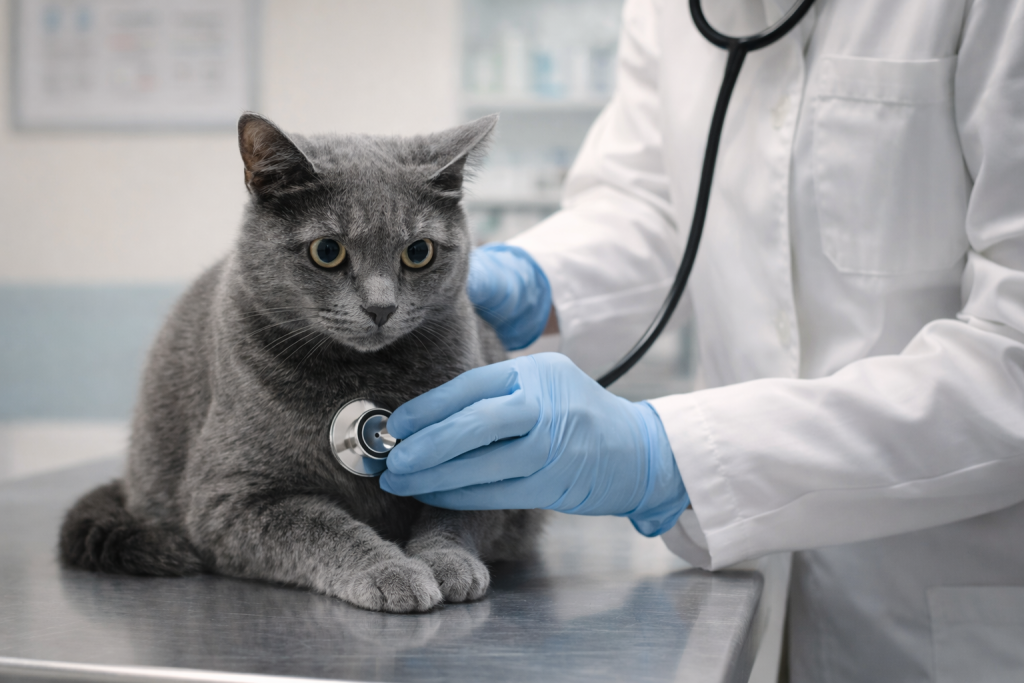
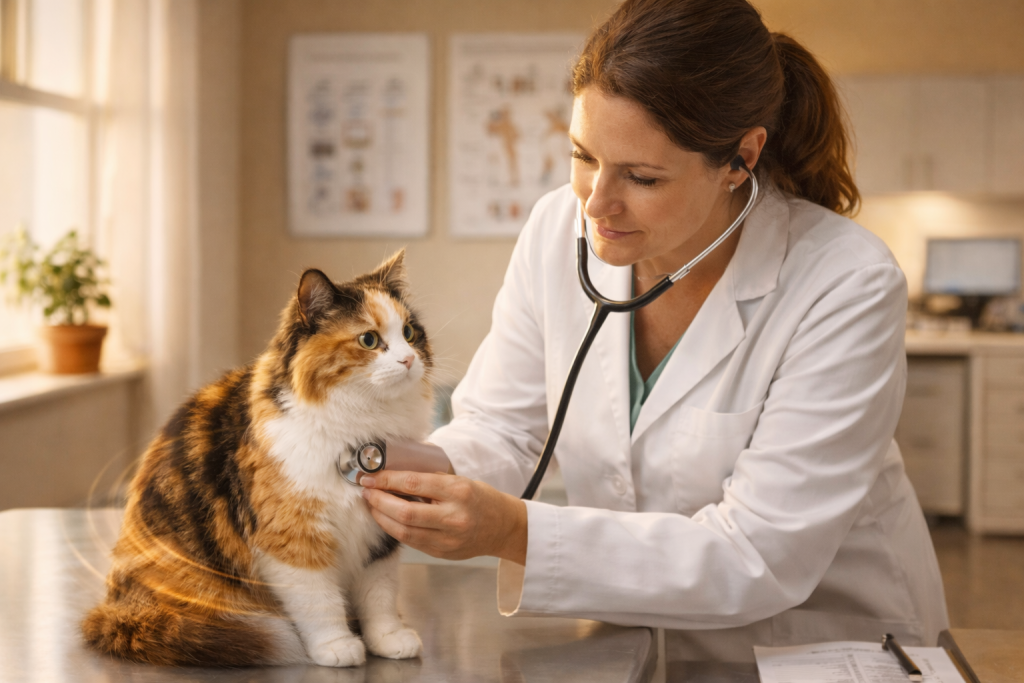
Veterinarians frequently observe this. Cats purr during medical examinations, even when clearly anxious.
Injured cats purr. Mother cats in labor purr. Cats at the end of their lives often purr.
How Stress Purring Differs
This type of purring tends to be different from contentment purring. It’s often higher-pitched, more urgent, or combined with other vocalizations.
Scientists now believe this serves as a self-soothing mechanism. Just as humans might hum or rock when anxious, they purr.
The Endorphin Connection
The act of purring might trigger the release of endorphins. Endorphins are natural pain-relieving chemicals in the brain.
These chemicals help the cat cope with stress or discomfort. This self-healing hypothesis aligns with the therapeutic frequency theory.
If purring promotes healing and reduces pain, it makes evolutionary sense. Cats would purr when injured or ill.
Your feline may be instinctively activating its own healing mechanism.
Communication During Distress
Additionally, purring during distress might serve a communication function. A sick or injured cat can’t flee from predators.
It might purr to signal non-aggression. The message is: “I’m not a threat, please don’t hurt me.”
Mother cats purring during labor might be reassuring. Felines comfort their kittens and themselves through a difficult process.
A Multifunctional Signal
This multifunctional aspect makes purring unique among animal vocalizations. Most animal sounds have specific, clear meanings.
A dog’s bark signals alarm or threat. A bird’s song attracts mates or defends territory.
Cat purring serves multiple purposes depending on context. We need to look at other behavioral cues to understand what the cat truly communicates.
The Solicitation Purr: When Your Cat Wants Something
Cat owners have long suspected something. Cats have different types of purrs for different situations.
Scientific Confirmation
Science has confirmed this intuition. Researchers call it the “solicitation purr.”
A study at the University of Sussex made an important discovery. Cats modify their purrs when they want something from their owners.
This happens particularly when they want food.
What Makes It Different
This solicitation purr contains a high-frequency component. It ranges from around 220 to 520 hertz.
Cats embed this within the lower-frequency rumble of normal purring. To human ears, it creates a slightly more urgent sound.
It’s something between a purr and a meow. Researchers Karen McComb and her team made another discovery.
Humans find this solicitation purr more urgent. It’s harder to ignore than regular purring.
Even people who aren’t cat owners respond this way.
Why It Works on Humans
The high-frequency component is similar to a baby’s cry. Humans are evolutionarily programmed to respond to that frequency.
Cats may have learned to exploit this acoustic similarity. Felines manipulate their owners into providing food, attention, or other resources. When people ask why cats do purr, they often don’t realize cats have actually evolved different purr types for different purposes.
Not All Cats Use It
Not all cats use the solicitation purr. It’s more common in cats that live one-on-one with a single owner.
Multi-cat households show less of this behavior. This suggests it’s a learned behavior.
Cats develop it through trial and error. Felines discover this particular sound gets results from humans.
An Evolutionary Adaptation
This manipulation isn’t calculated in a human sense. Instead, it represents an evolutionary adaptation to living with humans.
Over thousands of years of domestication, certain cats thrived. These were cats better at communicating their needs to humans.
Successful communicators were more likely to be fed and cared for. Humans allowed them to reproduce.
The solicitation purr may be one result of this selection process.
Wild Cats Don’t Do This
Interestingly, wild cats and feral cats are less likely to produce this purr. This supports the idea that it’s specifically adapted for human-cat communication.
It’s not for cat-to-cat interaction.
Purring as Communication: What Your Cat Is Really Saying
Beyond contentment and solicitation, purring serves as a versatile communication tool. Cats use it in various social interactions.
Mother-Kitten Communication
Mother cats use purring to communicate with their kittens early on. This happens before kittens can see or hear well.
The vibrations help kittens locate their mother. Newborns use these vibrations to find the milk source.
Kittens, in turn, purr while nursing. This signals to their mother that all is well.
A feedback loop of reassurance forms between mother and offspring.
Cat-to-Cat Purring
Adult cats sometimes purr when greeting each other. However, this is less common than with humans.
Purring typically signals peaceful intentions. It shows a willingness to engage socially.
Cats may also purr during grooming sessions with other cats. This reinforces social bonds within a group or colony.
Purring at Humans
When cats purr at humans, they’re often initiating social interaction. Felines are also maintaining it.
Your cat might purr to greet you when you come home. Purring can request petting.
It signals comfort with your presence. Some cats even purr in anticipation of positive events.
This happens when they hear the can opener. Anticipatory purring occurs when they see you preparing their food.
Volume and Pattern Matter
The volume and pattern of purring convey information. A loud, steady purr usually indicates strong contentment.
It can also signal a strong request. A soft, intermittent purr might suggest mild pleasure.
Tentative friendliness could be the message. Some cats trill or chirp.
These are short, high-pitched sounds mixed with purring. This often expresses excitement or friendly greeting.
Context Is Everything
To truly understand what your cat’s purr means, pay attention to the entire context. Look at body posture, tail position, and ear orientation.
Consider the situation. A cat purring with a relaxed body and slow blinks is content.
A cat purring with flattened ears is different. Add a tense body and dilated pupils—this cat might be stressed or in pain.
Context is everything. The question “why do they purr” becomes “what is my cat trying to communicate right now?” Context and body language provide the answer.
The Evolution of Purring: Why Did Cats Develop This Ability?
To understand why cats purr, consider the evolutionary pressures. Various forces shaped this behavior.
The Cost-Benefit Analysis
Purring requires energy and carries some risks. Making sound can attract predators.
It must provide significant benefits to have evolved and persisted.
Energy Efficiency Theory
One leading theory focuses on energy efficiency. Unlike meowing or yowling, purring requires little energy.
Meowing can only be done during exhalation. Purring can be continuous.
It occurs during both inhalation and exhalation. This makes it efficient for communicating over extended periods.
Minimal energy expenditure is required. This is ideal for animals that conserve energy through long rest periods.
The Mother-Kitten Bond
The mother-kitten bond likely played a crucial role. In the dangerous world of wild cats, keeping kittens quiet is essential.
Communicating with them is also essential. Louder vocalizations could attract predators to the vulnerable litter.
Purring is relatively quiet and low-pitched. Predators find it harder to locate.
Yet it still allows mother and kittens to maintain contact.
Self-Soothing and Healing
The self-soothing and healing properties of purring may have provided advantages. Cats that could reduce their own stress would survive better.
Those that managed pain effectively would survive. Those that healed faster from injuries would be more likely to reproduce.
Over many generations, purring became deeply embedded. It’s now in cat physiology and behavior.
Domestication’s Influence
The domestication process added another layer to purring evolution. Cats that were better at communicating with humans received benefits.
Better communicators got more care, food, and protection. This created selective pressure.
Cats developed and refined purring behaviors that appealed to humans. This includes the solicitation purr and the soothing contentment purr.
Ancient Origins
Interestingly, the 25-50 hertz frequency range appears across multiple cat species. This suggests it evolved before domestic cats diverged from wild ancestors.
This frequency may have been selected precisely because of its therapeutic properties. It gave early cats a biological advantage in harsh wild conditions.
Modern Cats Carry Ancient Adaptations
Today’s domestic cats are descendants of successful felines. These cats navigated both wild environments and human companionship.
Purring helped them survive both worlds. That’s why your modern house cat still carries this ancient adaptation.
You hear it in every rumbling vibration. Millions of years of evolution shaped why they purr, creating one of the most versatile vocalizations in the animal kingdom.
Do All Cats Purr the Same Way?
Not all cats purr identically. The variations tell us interesting things about individual cats and different species.
Individual Variation in Domestic Cats
Among domestic cats, purring frequency varies. Volume and duration differ by individual.
Some cats are vigorous purrers. These felines produce loud, sustained rumbles at the slightest provocation.
Others are quiet purrers. These cats produce barely audible vibrations.
You can only feel these by placing your hand on their chest. A few cats rarely purr at all, though this is uncommon.
Breed Differences
Breed can play a role in purring behavior. Siamese and other Oriental breeds tend to be more vocal overall.
These breeds may combine purring with other vocalizations more frequently. Maine Coons often have particularly loud, resonant purrs.
However, individual variation within breeds is significant. Personality matters more than genetics alone.
Early socialization also plays a major role.
The Silent Purr
Interestingly, some cats develop what’s called a “silent purr.” These felines go through all the motions of purring.
You can see visible vibrations. You feel the physical sensation of purring.
But they produce little to no audible sound. This might result from subtle anatomical differences in the larynx or vocal cords.
Wild Cat Purring Abilities
Among wild cat species, purring abilities vary considerably. Big cats cannot truly purr.
Lions, tigers, leopards, and jaguars lack this ability. The reason is differences in their hyoid bone structure.
The hyoid is a small bone in the throat that supports the tongue and larynx. These cats can roar instead.
Domestic cats cannot roar. The trade-off appears to be an evolutionary choice.
You can either purr or roar, but not both.
Which Wild Cats Can Purr
Smaller wild cats can all purr. Bobcats, lynxes, and cougars (mountain lions) have this ability.
Cheetahs, ocelots, and servals can also purr. Cheetahs are the largest cats that can purr.
These large spotted cats do so quite frequently. Cheetahs use purring for social bonding and mother-cub communication, much like domestic cats.
The Purring-Roaring Divide
This purring-roaring divide among cats has fascinated researchers for years. It appears to relate to the hyoid bone structure.
Cats with flexible hyoid structures can purr continuously. Those with fully ossified hyoids can roar but cannot produce sustained purring.
Health Benefits of Cat Purring for Humans
Most research on purring focuses on cats themselves. However, growing evidence suggests humans may benefit too.
Cardiovascular Benefits
These benefits go beyond the simple joy of cuddling with a furry companion. Multiple studies, including research from the Centers for Disease Control and Prevention, have found that cat owners have lower blood pressure.
Non-cat owners show higher blood pressure in comparison. Simply having a pet provides companionship and stress relief.
However, some researchers believe the specific frequency of purring may contribute. The vibration may enhance this cardiovascular benefit.
The rhythmic, soothing sound can induce a meditative state in humans. It creates a relaxed state.
Stress Reduction
Stress reduction is one of the most documented benefits. Petting a purring cat has been shown to lower cortisol levels.
Cortisol is a stress hormone. Petting also increases production of oxytocin.
Oxytocin is a bonding and relaxation hormone. The combination of tactile sensation, soothing sound, and companionship creates powerful stress relief.
Long-Term Health Outcomes
One long-term study found interesting results. Cat owners had a 30% lower risk of heart attack and stroke.
People who had never owned a cat showed higher risks. Causation is difficult to prove.
People who choose cats may already have certain health characteristics. However, the correlation is notable.
The calming effect of purring might play a role in this protective effect.
Therapeutic Applications
Some therapists and healthcare providers have explored using recorded purring sounds. These professionals use them for relaxation and pain management.
While research is still preliminary, anecdotal evidence is interesting. The 25-50 hertz frequency range may help some people relax.
It might reduce anxiety. It might even help manage chronic pain symptoms.
The Psychological Bond
There’s also the psychological benefit of the human-animal bond itself. Caring for a cat provides purpose and routine.
It provides unconditional companionship. When your cat purrs in your lap, it creates a moment of connection.
It creates calm in our often chaotic lives. These moments of peace accumulate over time.
Overall wellbeing benefits from this accumulation.
Important Caveats
Of course, these benefits are population-level trends. Individual experiences vary.
Having a cat isn’t a substitute for proper medical care. However, the evidence does suggest something important.
The relationship between humans and purring cats can be mutually beneficial. The benefits are often surprising. Understanding why do they purr might also help us understand why their ownership correlates with better human health outcomes.
When Purring Might Indicate a Problem
While purring is usually a positive sign, there are exceptions. Sometimes excessive or unusual purring indicates their needs veterinary attention.
Constant Excessive Purring
If your cat is purring constantly—far more than usual—pay attention. This is especially true if accompanied by other behavioral changes.
Watch for hiding, loss of appetite, or lethargy. These could signal illness or pain.
Remember that cats purr when they’re unwell as a self-soothing mechanism. Unusual purring combined with other symptoms warrants a vet visit.
Changes in Purr Quality
Changes in the sound or quality of purring can be significant. If your cat’s normally smooth purr becomes raspy, that’s noteworthy.
Intermittent purring where steady purring once existed could indicate a problem. Noticeable pitch changes might signal a respiratory issue or laryngeal problem.
Upper respiratory infections can affect the larynx. Infections can alter purring sounds.
Purring With Distress Signals
If your cat purrs while showing signs of distress, take note. Watch for rapid breathing, restlessness, or vocalization.
Aggressive behavior when touched is also concerning. The purring is likely a stress response rather than contentment.
This combination of signals often indicates pain. It indicates significant discomfort. This reveals another layer to why cats purr—it’s not just about happiness, but also about self-comfort during difficult times.
Sudden Cessation of Purring
A sudden stop in purring is worth noting. This applies to a cat that previously purred frequently.
Someof them naturally purr less as they age. However, a dramatic change in behavior can reflect changes in health.
It can reflect changes in wellbeing.
Context Matters
Context is crucial here too. A cat purring during a thunderstorm is probably self-soothing from fear.
This is understandable and normal. It might happen while sitting motionless in a corner for hours is different.
Such behavior is abnormal and should be investigated.
Trust Your Instincts
When in doubt, trust your instincts as a cat owner. You know your cat’s normal behavior patterns.
Significant deviations from those patterns should be discussed with your veterinarian. This includes changes in purring. Knowing why they purr helps you recognize when purring signals a problem rather than contentment.
The Purr That Connects Us: Understanding Your Cat’s Most Mysterious Sound
So why do cats purr? As we’ve discovered, there’s no single answer.
Cats purr when they’re happy. Felines purr when they’re stressed.
Your cat purrs when it wants something. Purring happens when they’re healing.
Communication drives much of this behavior. This multifunctional vocalization is one of nature’s most elegant adaptations.
It’s a low-energy sound that serves multiple purposes. Social, therapeutic, and communicative functions all exist at once.
The 25-50 hertz frequency of purring may promote bone density. It may promote tissue healing.
Cats have a built-in physical therapy system. The sound itself facilitates communication between mothers and kittens.
It facilitates communication between cats and other cats. Most importantly, it facilitates communication between cats and their human companions.
Over thousands of years of living alongside humans, They have refined their purring. It’s become a sophisticated tool for manipulating our emotions and behaviors.
And we’re happy to be manipulated.
Next time your cat settles into your lap and starts that familiar rumbling, appreciate what’s happening. Complex biology is at work.
Evolutionary history unfolds. Intentional communication occurs.
All of this happens in that simple sound. Your cat might be saying “I’m content.”
Perhaps the message is “I want dinner.” Maybe it’s “I’m comforting myself.”
Or possibly all three at once.
The fact that scientists still don’t fully understand every aspect of purring is telling. Even our closest animal companions retain some mystery.
And perhaps that’s part of what makes the bond between humans and cats so special. That soothing vibration connects us to millions of years of evolution.
It connects us to thousands of years of shared history. All in a single purr.
FAQ: Common Questions About Cat Purring
Can cats purr and meow at the same time?
Technically, cats cannot truly purr and meow simultaneously. Both sounds are produced by the larynx.
The muscle contractions required for each are different. However, they can rapidly alternate between purring and meowing.
Rapid alternation creates what sounds like a combined vocalization. This is often part of the solicitation purr.
They incorporate meow-like sounds into their purring. Your attention is captured more effectively this way.
Why do cats purr so loudly?
Some cats naturally purr more loudly than others. Individual anatomical differences in their larynx and chest cavity explain this.
Breeds like Maine Coons tend to have particularly loud purrs. Additionally, enthusiastic, confident cats often purr more loudly than timid ones.
If your cat’s loud purring is new, consult your vet. Also check if it’s accompanied by other symptoms like coughing or difficulty breathing.
Respiratory issues could be the cause.
Do cats only purr around humans?
No, cats purr in various situations that don’t involve humans at all. Mother cats purr while nursing kittens.
Adult cats sometimes purr when greeting each other. Cats purr when alone as a self-soothing mechanism.
However, domestic cats do seem to purr more frequently around humans. Felines purr more elaborately around humans than with other cats.
Research suggests they’ve adapted this behavior specifically for human communication.
Why does my cat purr and then bite me?
This behavior is sometimes called “petting aggression.” It occurs when a cat becomes overstimulated during petting.
Your cat may purr initially because they enjoy the interaction. But as it continues, they reach a threshold.
The sensation becomes irritating or overwhelming. The sudden bite is their way of saying “enough.”
Watch for warning signs before the bite. Look for tail twitching, ear flattening, or skin rippling.
Stop petting before your cat reaches this point.
Can a cat purr when it’s sleeping?
Yes, cats can purr while sleeping. However, it’s less common than purring while awake.
When it does happen, it usually occurs during light sleep. Transition periods between waking and sleeping can trigger purring.
The purring might indicate your cat is having pleasant dreams. Feeling especially comfortable and secure could be the reason.
Or they’re simply maintaining the purr from before falling asleep through automatic muscle memory.
Is it normal for older cats to purr less?
Some older cats do purr less frequently as they age. However, this isn’t universal.
Changes might result from decreased energy levels. Arthritis making them less comfortable could be a factor.
Simply changing personality with age is also possible. However, a dramatic decrease in purring should be noted.
Accompanying behavioral changes make this especially concerning. Health issues could be present and should be discussed with your veterinarian.
Why do some cats “knead” while purring?
Kneading is the rhythmic pushing of paws against a soft surface. Combined with purring, it’s a behavior that originates in kittenhood.
Kittens knead their mother’s belly while nursing. This stimulates milk flow, and they purr while doing so.
Adult cats retain this association between kneading, purring, and contentment. Felines remember the feeling of security they experienced as kittens.
When your cat kneads and purrs on you, they’re expressing extreme comfort. Your feline is treating you like their mother—the highest compliment a cat can give.
Discover more from Factopiax
Subscribe to get the latest posts sent to your email.