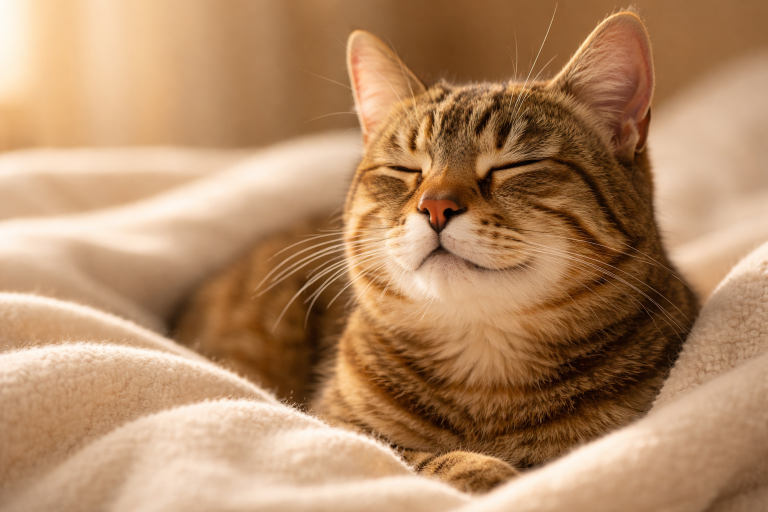

If you’ve ever tried to bathe a cat, you already know the answer feels obvious — cats hate water, full stop. But that explanation misses something far more interesting. The real question isn’t just why do cats hate water, it’s why domestic cats behave so differently from their wild cousins. Tigers wade into rivers to cool down. Jaguars chase fish through jungle streams. The fishing cat of Southeast Asia practically lives in the water. So why does your tabby treat a dripping tap like a personal threat?
The answer runs deeper than preference. It goes all the way down to evolutionary biology, coat chemistry, ancestral geography, and the neuroscience of sensory discomfort. Understanding this split between the house cat and the big cat doesn’t just explain a funny quirk — it reveals how powerfully habitat shapes an animal’s biology over thousands of generations.
By the end of this post, you’ll understand the full evolutionary story behind feline water aversion, the surprising science of cat fur, which big cats love to swim and why, and the domestic breeds that actually buck the trend.
Table of contents
- Desert Origins of the Domestic Cat
- Why Staying Dry Was a Survival Advantage
- How Instinct Became Inheritance
- Domestication Didn’t Change the Water Aversion
- Fur Coat Science: Why Cat Fur Fails in Water
- Body Temperature and Why Water Hits Cats Harder
- Why Tigers, Jaguars, and Fishing Cats Love Swimming
- Breed Variations: The Domestic Cats That Actually Like Water
- Sensory Biology: The Overlooked Reason Cats Hate Water
- How Water Disrupts Whisker-Based Navigation
- Paw Pads: High‑Sensitivity Sensors That Hate Cold Water
- The Brain’s “Abort Mission” Response
- When Cats Do Swim: Survival Instincts and Surprising Exceptions
- Frequently Asked Questions
- Conclusion
Desert Origins of the Domestic Cat
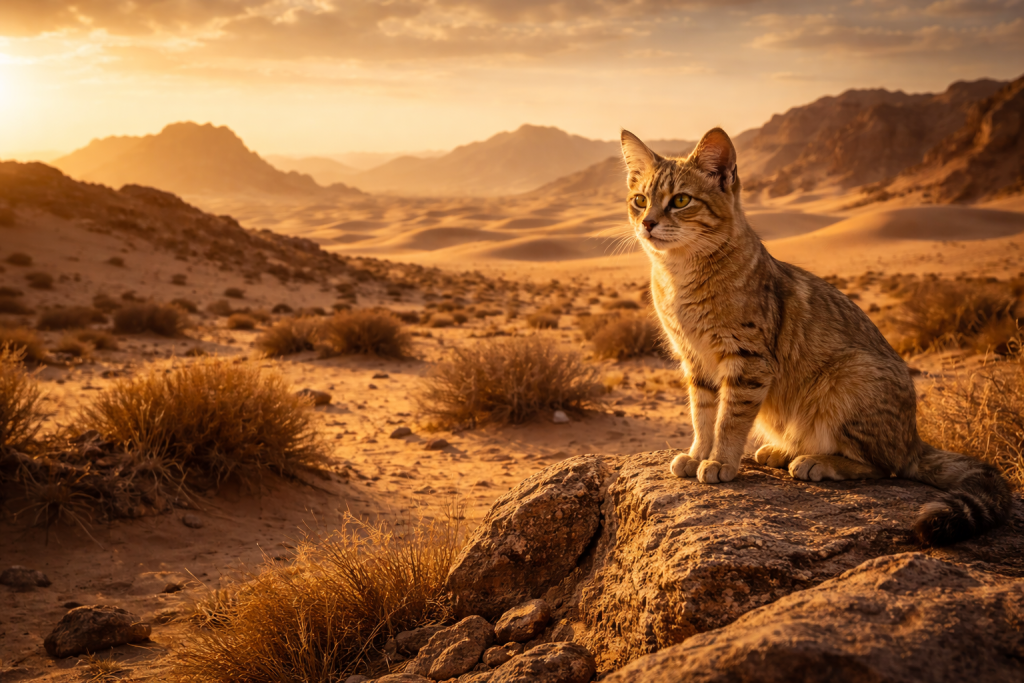
To understand why cats hate water today, you have to go back roughly 10,000 years — to the dry, arid landscapes of North Africa and the Middle East.
The domestic cat’s primary wild ancestor is Felis silvestris lybica, the African wildcat. This small, sand‑coloured predator evolved in some of the driest environments on Earth — the Fertile Crescent, the Sahara’s fringes, and the rocky scrublands of the Middle East. In these landscapes, large bodies of freshwater were rare. Rivers and lakes were not a regular feature of daily life. As a result, Felis lybica never needed to develop a relationship with water the way mammals evolving near rivers, lakes, or coastlines did.
Why Staying Dry Was a Survival Advantage
Evolution produces traits because they offer a survival advantage. For the African wildcat, avoiding water wasn’t a quirk — it was practical. A wet cat in a desert environment loses body heat rapidly. Because cats regulate temperature primarily through their skin and coat rather than through panting or sweating the way dogs do, a soaked coat disrupts their thermal regulation in ways that can be genuinely dangerous.
Wet fur in the wild is also a liability. A heavy, water‑logged coat slows movement, reduces agility, and increases vulnerability. For a small solitary hunter that relies on stealth and precise bursts of speed, these disadvantages are significant.
How Instinct Became Inheritance
Over thousands of generations, the cats that were most reluctant to enter water tended to survive better in these conditions. That behavioural preference became embedded in feline instinct — passed down through domestication all the way to the cat currently glaring at your shower.
Domestication Didn’t Change the Water Aversion
When humans began domesticating cats around 10,000 years ago — primarily for rodent control in early agricultural settlements — they selected for tameness and hunting ability, not water tolerance. The desert‑inherited instincts came along unchanged.
Fur Coat Science: Why Cat Fur Fails in Water
Even if a cat were willing to enter water, their coat would make the experience deeply unpleasant — and this is where some genuinely fascinating biology comes in.
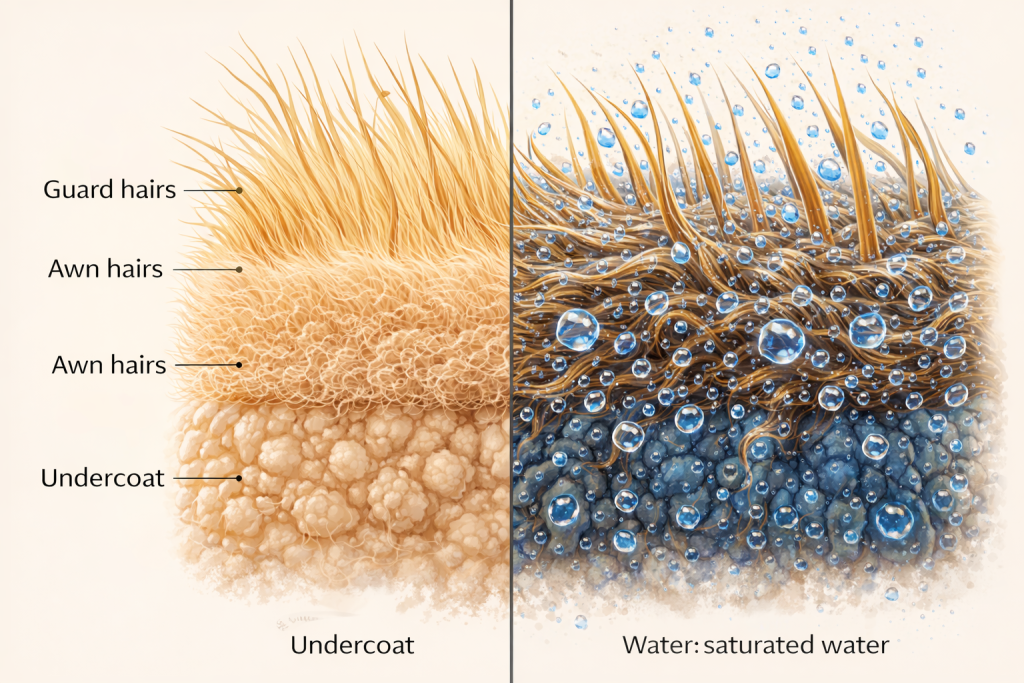
Cat fur has a layered structure. Most domestic cats have three distinct layers: a dense, soft undercoat closest to the skin, a middle layer of slightly coarser hairs called awn hairs, and an outer layer of longer guard hairs. This structure is excellent for insulation, camouflage, and protection from minor abrasions. However, it is not water-resistant.
Contrast this with animals that evolved in or near water. Otters have fur coated with natural oils that cause water to bead and roll off the surface — their undercoat stays almost completely dry even during extended dives. Dogs that were bred for water work, like Labrador Retrievers, have a dense double coat with water-resistant outer hairs and a thick, oily undercoat that repels moisture. Many waterfowl produce preen gland oils that waterproof their feathers entirely.
Cat fur has none of these adaptations. Water penetrates all three layers immediately, during a cat getting wet. The undercoat becomes saturated and clumps together. This is why a wet cat looks so dramatically different — and so notably miserable. The soaked fur is suddenly heavy, cold, and completely loses its insulating property. Rather than trapping warm air close to the skin, a saturated cat coat acts almost like a cold compress pressed against the body.
Additionally, cats are meticulous groomers. They spend between 30 and 50 percent of their waking hours cleaning their fur. A soaking undoes all of that work in seconds — and the cat knows it will need to spend significant energy returning their coat to a functional condition. From the cat’s perspective, getting drenched is both physically unpleasant and an enormous practical setback.
Body Temperature and Why Water Hits Cats Harder
The thermal regulation issue deserves its own examination, because it explains a lot about the intensity of cats’ water aversion — not just its existence.
Cats are what biologists call “obligate hyperthermics.” Their normal body temperature range (38 to 39.2°C, or roughly 100 to 102.5°F) runs higher than most mammals of comparable size. Maintaining this elevated core temperature requires efficient insulation — which is exactly what their layered fur coat provides under dry conditions.
When that coat becomes wet, heat loss accelerates dramatically. Water conducts heat away from the body approximately 25 times faster than air does. A saturated cat coat, rather than trapping warmth, actively pulls heat away from the skin. Even in a warm room, a thoroughly drenched cat can experience a meaningful drop in core temperature — which triggers physiological stress responses including shivering, elevated cortisol, and increased heart rate.
Moreover, cats cannot generate body heat quickly through shivering the way many larger mammals can. Their relatively small muscle mass means that the metabolic heat production from shivering is limited. So not only does the cat lose heat faster when wet — it also has fewer tools to recover it rapidly.
Beyond temperature, there’s a comfort dimension that’s easy to underestimate. Cats have evolved to feel in control of their physical environment at all times. Water removes that sense of control completely. A wet coat changes how the animal moves, how it feels, and how efficiently it can operate as a predator. For an animal hardwired around self-sufficiency and precision, this is genuinely distressing — not just mildly annoying.
Why Tigers, Jaguars, and Fishing Cats Love Swimming
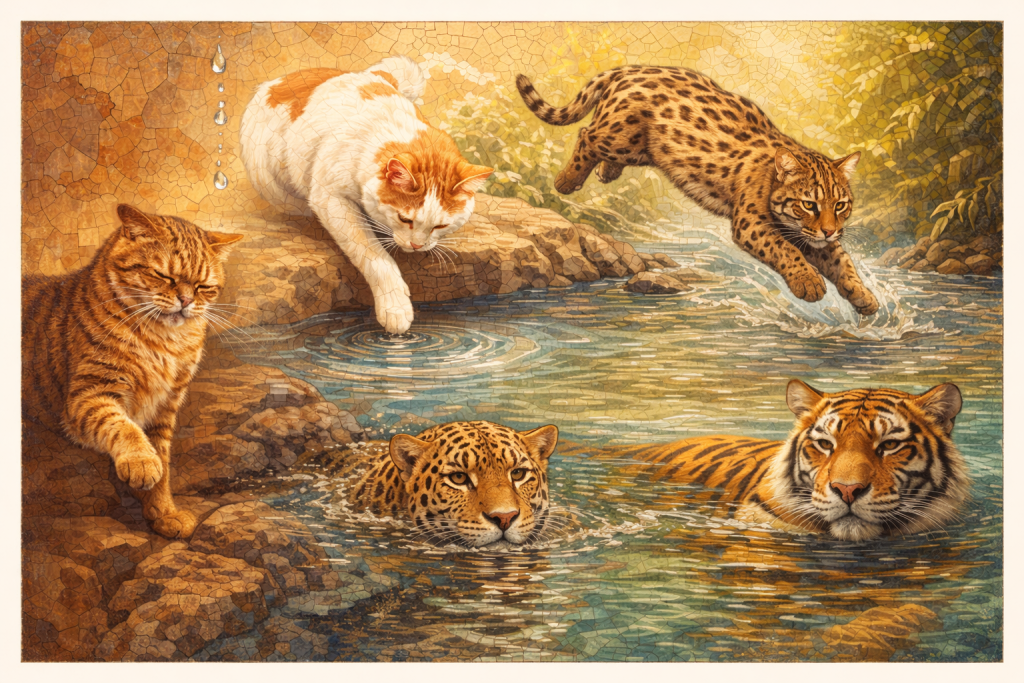
Here’s where the story gets really interesting. The same evolutionary logic that made domestic cats water-averse also explains why certain big cats are enthusiastic, capable swimmers — because their ancestors evolved in completely different environments.
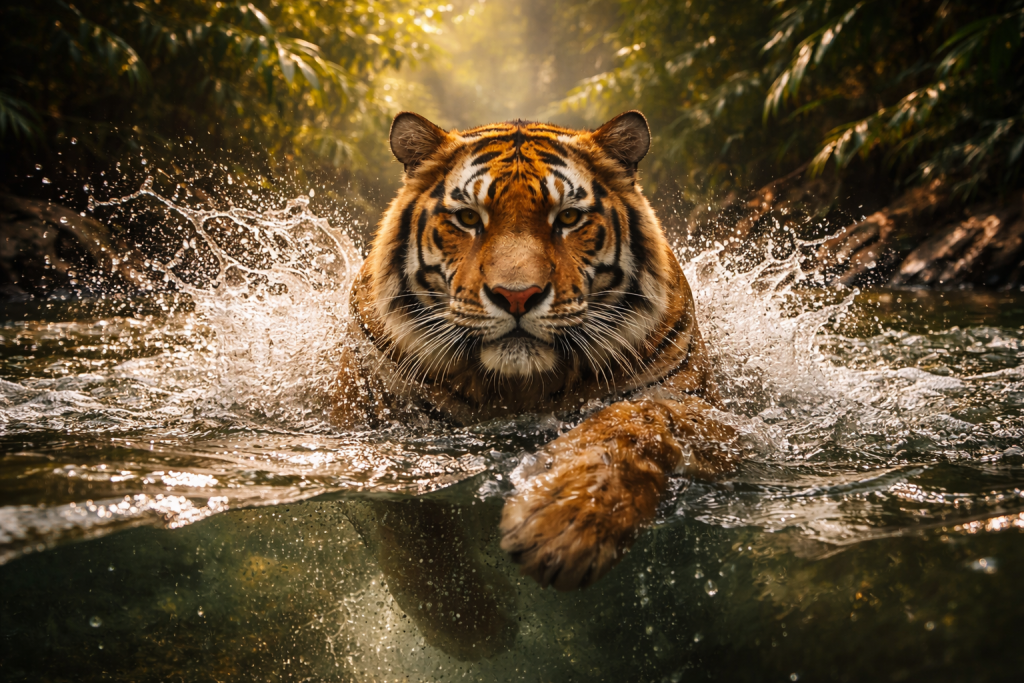
Tigers are perhaps the most famous example. Found across South and Southeast Asia — from the mangrove swamps of the Sundarbans to the river-threaded jungles of Indonesia — tigers evolved in habitats where water was everywhere. For a tiger, rivers and lakes weren’t obstacles. They were hunting grounds, cooling stations, and territorial boundaries to cross.
As a result, tigers developed several biological adaptations that domestic cats simply don’t have. Their coat, while dense, has a more water-resistant outer layer better suited to repeated wetting and drying. More importantly, tigers are large enough that the heat-loss equation works differently. A 200-kilogram tiger has enormous thermal mass — it can afford to lose surface heat to water far more easily than a 4-kilogram domestic cat, because its core temperature recovers far more efficiently.
Jaguars present an equally compelling case. The jaguar is the apex predator of South America’s Amazon basin — one of the most water-rich ecosystems on Earth. Jaguars actively hunt in rivers, catching fish, caimans, and anacondas. They are extraordinarily powerful swimmers which have been documented crossing wide rivers without hesitation. Their muscular build, broader paws, and comfort in aquatic environments are all products of evolutionary pressure from a river-dense habitat.
The Fishing Cat: Nature’s Most Water-Adapted Small Cat
The fishing cat (Prionailurus viverrinus) is perhaps the most striking example of evolution reshaping feline water behaviour. Found in wetlands across South and Southeast Asia, this medium-sized wild cat has partially webbed front feet, a shorter, denser coat with a water-resistant texture, and hunting techniques specifically adapted to shallow water — scooping fish with its paws or diving directly into streams headfirst.
The fishing cat didn’t “decide” to like water. Its entire anatomy was shaped by thousands of generations of wetland living. Compared to a domestic cat, it’s almost a different design philosophy from the same basic blueprint.
Breed Variations: The Domestic Cats That Actually Like Water
The picture gets even more nuanced when you look at domestic cat breeds — because not all house cats hate water equally, and the reasons why reveal just how much genetics shapes behaviour.
The Turkish Van is the most famous water-loving domestic breed. Originating from the Lake Van region of eastern Turkey — an area dominated by a large, freshwater lake — Turkish Vans developed a unique coat texture that is cashmere-like, semi-water-resistant, and considerably less prone to saturation than standard cat fur. Local legend called them “the swimming cat,” and they earned the nickname biologically . Turkish Vans have been observed entering water voluntarily and appear to find it genuinely stimulating rather than threatening.
Bengal cats — a hybrid breed developed from crosses between domestic cats and Asian Leopard Cats — also show notably stronger water tolerance and curiosity than typical domestic cats. This is almost certainly an inheritance from their wild ancestor. The Asian Leopard Cat is a proficient swimmer that frequently hunts in and around water. That comfort around water appears to have carried forward into the Bengal’s temperament.
The Maine Coon, one of the largest domestic breeds, is another exception. Their dense, water-resistant outer coat — thought to have evolved for harsh northeastern American winters — gives them greater tolerance for moisture. Cats that Maine Coon owners frequently describe as fascinated by running taps, playing in water bowls, and willingly following their owners into bathrooms—without the usual feline alarm—are showing behaviours those owners actively observe and report.
Furthermore, individual experience matters alongside genetics. Cats that people introduce to water gradually and positively from a young age show measurably less aversion than cats whose first exposure comes as a stressful adult bath. Behaviour is always a combination of hardwired instinct and lived experience.
Sensory Biology: The Overlooked Reason Cats Hate Water
One more dimension of the answer to why cats hate water is almost entirely about sensory biology — and it’s one that most casual explanations overlook entirely.
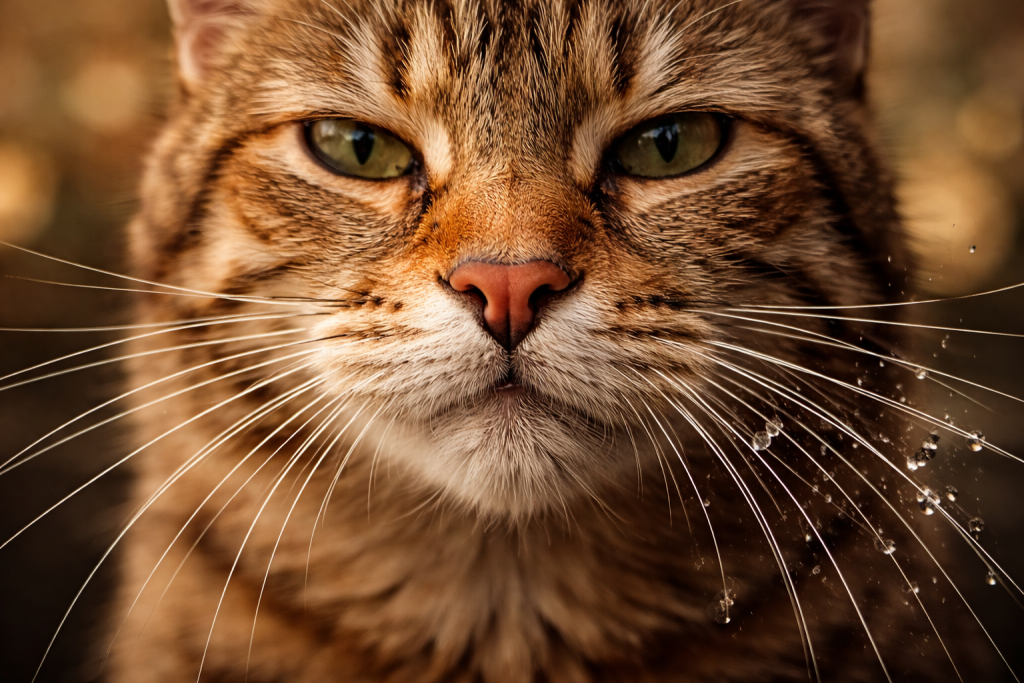
Cats are among the most sensorially sensitive mammals on Earth. Their whiskers — technically called vibrissae — aren’t just for measuring gap widths. They contain extraordinary sensory organs packed with nerve endings that detect minute changes in air pressure, vibration, and spatial information. Whiskers give cats real-time feedback about their environment with extraordinary precision.
How Water Disrupts Whisker-Based Navigation
Water disrupts all of this. Wet whiskers transmit radically different sensory signals than dry ones. The usual precise feedback a cat relies on — where the wall is, whether a gap is passable, and what direction air is moving from — scrambles when soaked, clumped whiskers distort those signals. For a predator that depends on microsecond sensory accuracy, this isn’t simply uncomfortable. It’s disorienting at a neurological level.
Paw Pads: High‑Sensitivity Sensors That Hate Cold Water
Cat paws are similarly over-equipped. The paw pads contain some of the highest concentrations of sensory receptors in the cat’s body — more than almost anywhere else on the surface. These receptors are exquisitely sensitive to temperature, texture, pressure, and vibration. When a cat steps into cold water, the temperature shock registers across thousands of nerve endings simultaneously. The feedback is immediate, intense, and strongly aversive.
Additionally, cats have a thin layer of skin between their toes that is especially sensitive to temperature. Cold water contacting this skin triggers a reaction that intensifies far beyond what a dog typically feels when walking through puddles. Dogs have far less sensory sensitivity in their paw pads and correspondingly far less distress from wet ground contact.
The Brain’s “Abort Mission” Response
In this sense, a cat’s hatred of water isn’t stubbornness. It’s biology. Every wet whisker and cold paw pad sends urgent “abort mission” signals to a brain evolution has wired to take those warnings seriously.
When Cats Do Swim: Survival Instincts and Surprising Exceptions
Here is something most cat owners don’t realise: virtually all domestic cats can swim. They just strongly prefer not to.
When people place cats in water without giving them an immediate way out, the cats demonstrate a competent—if unelegant—swimming stroke, a rapid paddling that keeps them afloat and moving. They do not panic and sink. They navigate toward the nearest exit with clear intent. Their survival instinct overrides the aversion when no alternative exists.
This matters because it confirms that the hatred of water isn’t a physical incapacity. It remains a behavioural preference — one supported by deep evolutionary logic, but still a preference. Given sufficient motivation, cats will enter and traverse water. Wild domestic cats in flood-prone regions have been documented swimming across flooded fields to reach dry ground. Feral cats living near coastlines or rivers learn to fish, albeit far less elegantly than fishing cats.
Viral video culture has produced some genuinely surprising examples. Cats chasing after fish in garden ponds and voluntarily entering paddling pools on hot days, then looking deeply confused about their own life choices. These cases are outliers, but they confirm the underlying flexibility of feline behaviour when curiosity or prey drive overrides caution.
Furthermore, cats’ relationship with water isn’t uniformly negative — it’s specifically about immersion. Many cats are fascinated by running water from a tap, will dip a paw into a water bowl, or will sit at the edge of a bathtub watching water drain with intense focus. The aversion is to being wet, not to water as a phenomenon. There’s a meaningful distinction there — and it likely reflects the sensory curiosity of a highly intelligent predator evaluating something strange, from a safe distance.
Frequently Asked Questions
Why do cats hate water so much?
The aversion to water in domestic cats is rooted in evolutionary biology rather than simple preference. Their wild ancestors — primarily the North African wildcat Felis silvestris lybica — evolved in arid, desert environments where large bodies of water were rare. As a result, cats never developed water-resistant fur coats or the physiological adaptations needed to handle immersion comfortably. When wet, a cat’s coat loses its insulating properties rapidly, causing heat loss, physical discomfort, and sensory overload through their sensitive whiskers and paw pads. Thousands of years of desert ancestry means the instinct to avoid water is deeply embedded.
Can all cats swim if they need to?
Yes — virtually all domestic cats are physically capable of swimming. When placed in water with no immediate escape route, cats demonstrate a functional paddling stroke and navigate toward the nearest exit with clear intent. However, swimming is an emergency response, not a chosen behaviour. The experience is deeply unpleasant for them due to fur saturation, heat loss, and sensory disruption. Their ability to swim when survival demands it simply confirms that the water aversion is a behavioural preference shaped by evolution, not a physical limitation.
Why do tigers and jaguars love water if cats hate it?
Tigers and jaguars evolved in vastly different environments from domestic cats. Tigers developed in the river-threaded jungles and wetlands of Asia, where water was an unavoidable and exploitable feature of their habitat. Jaguars are apex predators of the Amazon basin and actively hunt fish, caimans, and other aquatic prey. Both species evolved physiological adaptations — larger thermal mass, more water-tolerant coats, broader paws — that make immersion manageable rather than distressing. It’s the same basic feline biology applied to a completely different evolutionary context.
Are there domestic cat breeds that like water?
Yes, several breeds show notably stronger water tolerance or curiosity than average. The Turkish Van, which originated near Lake Van in Turkey, has a semi-water-resistant coat and a well-documented fondness for water. Bengal cats inherit water comfort from their Asian Leopard Cat ancestry. Maine Coons, with their dense water-resistant outer coats, frequently show interest in running water and tolerate bathing better than most breeds. In all these cases, the difference traces back to specific ancestry and coat genetics — not random personality variation.
Do cats’ whiskers make water feel worse for them?
Absolutely — and this is one of the most underappreciated reasons why do cats hate water so strongly. Whiskers are densely packed sensory organs that provide real-time spatial and environmental feedback. When soaked, they transmit scrambled, overwhelming signals that disorient the cat’s usual precise perception of its surroundings. Similarly, the paw pads — which contain some of the highest concentrations of sensory nerve endings in the cat’s body — register the temperature and texture of water with extreme sensitivity. The combined sensory experience of wet whiskers and cold paws sends powerful “danger” signals that the brain has been evolutionarily tuned to take seriously.
Conclusion
The question of why cats hate water turns out to be a window into one of biology’s most elegant stories — how environment shapes an animal’s entire relationship with the world, right down to the nerve endings in its paws. Your cat isn’t being dramatic. It’s carrying 10,000 years of desert ancestry in every wet, miserable whisker.
And that contrast with the tiger lazily floating downstream in a Bengal river? That’s evolution doing what it does best — taking the same basic blueprint and producing radically different outcomes based on where and how an animal had to survive. Same family. Different worlds. Completely different relationship with water.
If you found this deep-dive into feline evolutionary biology as fascinating as we did, there’s plenty more where that came from at FactoPiaX. We cover the science behind animal behaviour, evolutionary biology, and the natural world’s strangest questions — all in a way that’s easy to follow and impossible to stop reading. Head over to our YouTube channel for visual breakdowns of topics just like this one.
Discover more from Factopiax
Subscribe to get the latest posts sent to your email.