
Have you ever woken up from a bizarre dream and wondered what on earth your brain was doing while you slept? Maybe you were flying over your childhood home, having a conversation with someone who’s been gone for years, or showing up to work completely naked. These nocturnal adventures feel incredibly real in the moment, yet they often make absolutely no sense when you try to recall them over morning coffee.
The question “why do we dream?” has puzzled humanity for thousands of years. Ancient Egyptians believed dreams were messages from the gods. Sigmund Freud thought they revealed hidden desires. Your grandmother might say spicy food causes weird dreams. But what does modern neuroscience actually tell us? The answer turns out to be far more fascinating than any single explanation—and scientists are still uncovering new pieces of this puzzle.
Dreams occur during specific sleep stages, primarily during REM (rapid eye movement) sleep when your brain shows activity patterns remarkably similar to waking consciousness. Every night, you cycle through multiple dream episodes, spending roughly two hours total in this strange mental state. Your brain is processing memories, regulating emotions, solving problems, and potentially doing housekeeping that keeps your mind healthy. Understanding why we dream reveals fundamental truths about consciousness, memory, and what it means to be human.
The Brain’s Nightly Theater – What Happens When You Dream
Let’s start with what actually occurs in your skull during dreams. When you fall asleep, your brain doesn’t simply shut down like a computer. Instead, it cycles through distinct stages, each with different brain wave patterns and purposes.
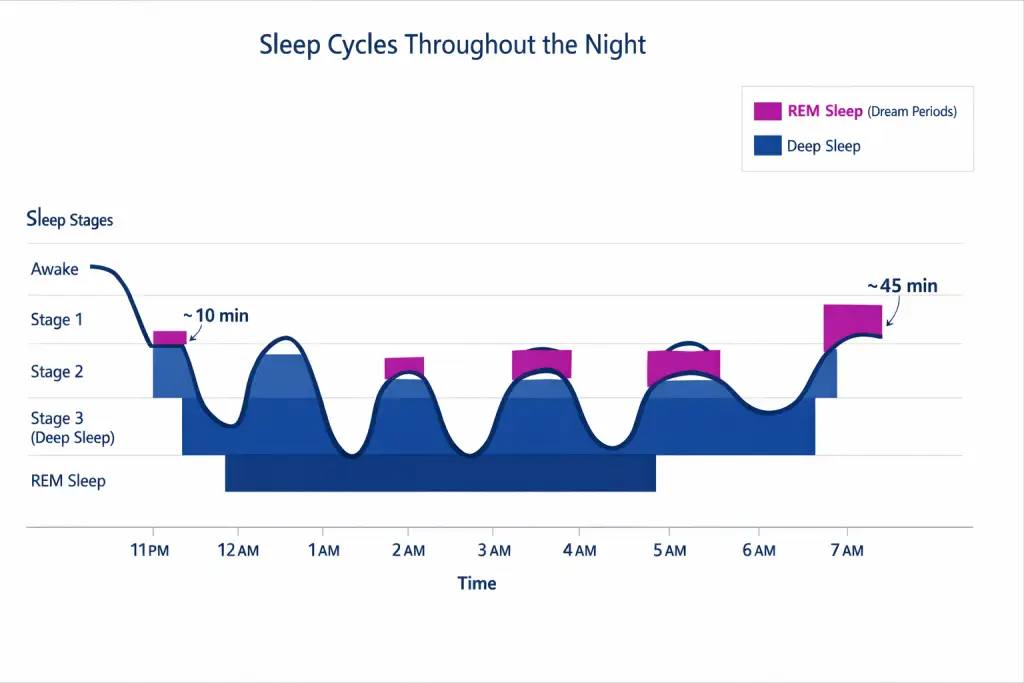
During the first phases of sleep—stages 1 and 2 of non-REM sleep—your brain waves slow down. You’re drifting away from consciousness, your muscles relax, and your body temperature drops slightly. Stage 3, called deep sleep or slow-wave sleep, is when your brain produces the slowest delta waves. This is the most restorative sleep phase for your body, when tissue repair and growth hormone release occur.
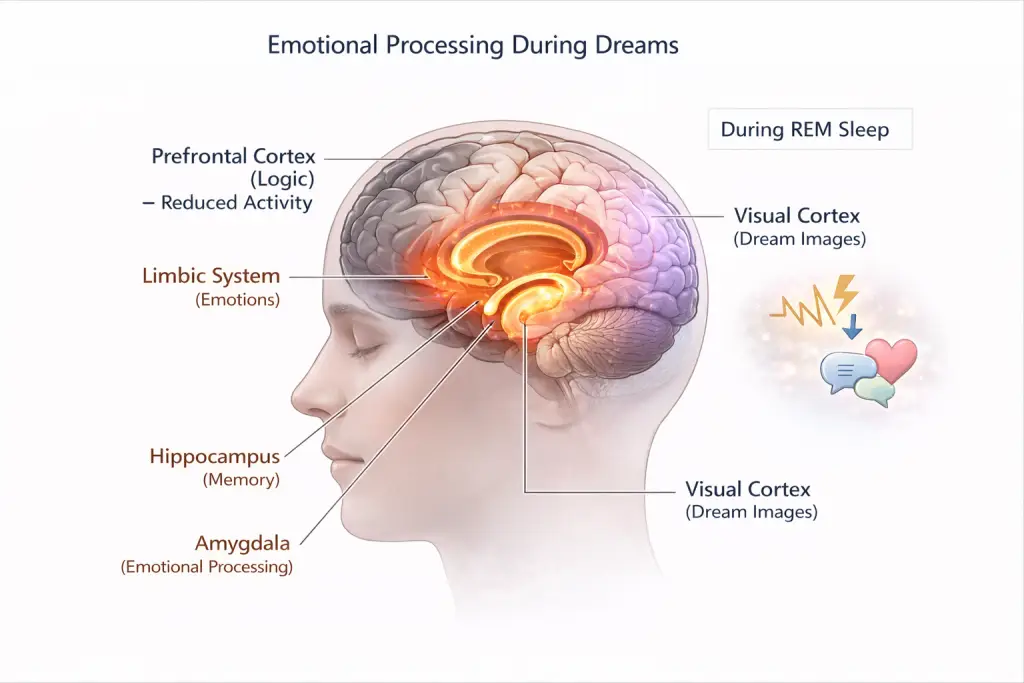
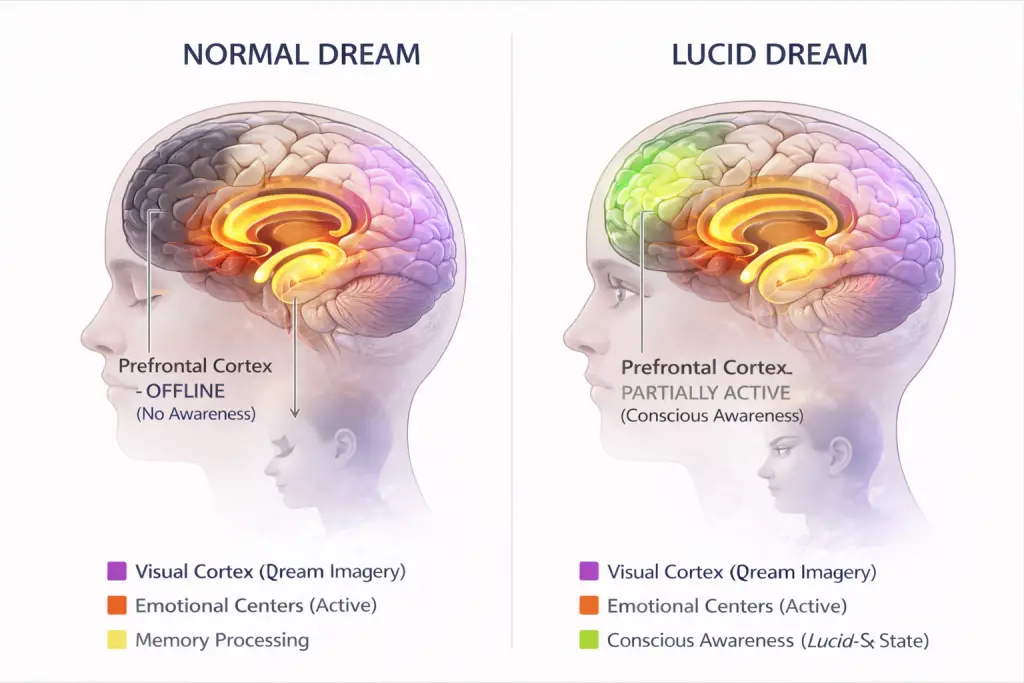
Then something remarkable happens. About 90 minutes after you fall asleep, you enter REM sleep—and your brain suddenly springs back to life. Brain scans during REM sleep reveal activity levels nearly identical to waking consciousness. Your visual cortex lights up despite your eyes being closed. Your emotional centers, particularly the amygdala and limbic system, become highly active. Yet curiously, your prefrontal cortex—the rational, logical part of your brain—shows significantly reduced activity.
The REM Sleep Phenomenon
This unique combination of active emotional centers and dampened logical thinking explains why dreams feel so vivid and strange. Your brain generates intense sensory experiences and emotional content, but the part that normally says “wait, this makes no sense” is essentially offline. That’s why you can accept impossible scenarios in dreams—talking animals, flying without wings, or being simultaneously in two places—without questioning them until you wake up.
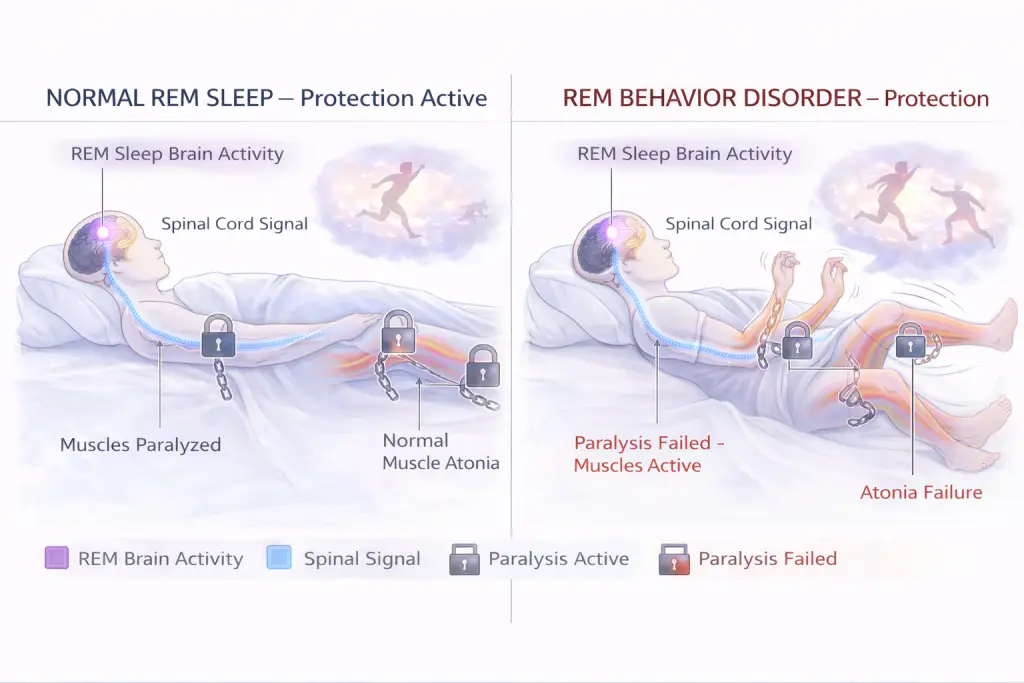
During REM sleep, your eyes move rapidly beneath your eyelids (hence the name), your heart rate increases, and your breathing becomes irregular. Meanwhile, most of your voluntary muscles become temporarily paralyzed—a protective mechanism called REM atonia that prevents you from physically acting out your dreams. When this mechanism fails, people experience REM sleep behavior disorder, actually moving and sometimes injuring themselves during vivid dreams.
You experience multiple REM cycles each night, with each episode lasting longer than the previous one. Your first REM period might last only 10 minutes, while the final one before waking could extend beyond 30 minutes. This is why your most vivid, memorable dreams typically happen in the early morning hours, and why your alarm often interrupts elaborate dream narratives.
Theory #1 – Dreams Process and Consolidate Memories
One of the most well-supported explanations for why we dream centers on memory consolidation. Your brain doesn’t just passively record experiences like a video camera. Instead, it must actively process, organize, and integrate new information with existing knowledge—and mounting evidence suggests dreams play a crucial role in this process.
Research published in Nature Neuroscience demonstrates that during REM sleep, your hippocampus—the brain’s memory center—replays experiences from your day. Brain scans show neurons firing in patterns that mirror the same sequences activated during waking experiences. If you learned a new skill during the day, your brain literally practices it again while you sleep, strengthening the neural pathways associated with that skill.
This explains why students who study before sleep and then get adequate rest perform better on tests than those who stay up all night cramming. The sleep, specifically the dream-filled REM stages, allows their brains to process and solidify what they learned. Studies tracking people learning new physical skills—from piano melodies to complex dance routines—show performance improvements after sleep that don’t occur with equivalent rest periods without REM sleep.
The Memory Sorting Process
Dreams don’t just replay memories verbatim. They seem to extract meaningful patterns and integrate new information with existing knowledge networks. That’s why you might dream about your new workplace mixed with elements from your childhood home, or dream characters might be composites of different people you know. Your brain is connecting new experiences to established memory structures, creating associations that help with recall and understanding.
Neuroscientist Matthew Walker’s research at UC Berkeley reveals that REM sleep doesn’t just strengthen memories—it also helps you forget irrelevant details. Your brain appears to determine what information deserves long-term storage and what can be discarded. Dreams might be the subjective experience of this sorting process, as your brain sifts through the day’s events, deciding what matters and what doesn’t.
This memory hypothesis explains why emotional or significant events appear more frequently in dreams than mundane details. Your brain prioritizes processing experiences that carried emotional weight or potential importance for future behavior. The time you got lost driving to a new location is more likely to appear in dreams than your routine commute, because your brain identifies it as information worth integrating into your mental map.
Theory #2 – Dreams Regulate Emotions and Process Trauma
Beyond memory consolidation, dreams appear to serve crucial emotional functions. Have you noticed that emotionally charged events from your day often show up in your dreams, sometimes in disguised or symbolic forms? This isn’t random—it’s your brain working through feelings and experiences that require emotional processing.
The amygdala, your brain’s emotional center, shows particularly high activity during REM sleep. Simultaneously, stress hormone levels drop significantly during this stage. Researchers propose that this combination allows your brain to reprocess emotional experiences in a neurochemically safe environment—you can revisit difficult experiences without the flood of stress hormones that accompanied the original event.
Studies of people with post-traumatic stress disorder (PTSD) reveal disrupted REM sleep patterns and recurring nightmares that replay traumatic events. The dreams don’t successfully process the trauma because the brain remains in a high-stress state even during sleep. Effective PTSD treatments often normalize sleep patterns, suggesting that healthy dreaming is essential for emotional recovery.
The Overnight Therapy Session
Neuroscientist Rosalind Cartwright, who studied dreams for over 40 years, called sleep “overnight therapy.” Her research with people going through divorce showed that those who dreamed about their ex-spouses and the breakup showed better emotional adjustment a year later compared to those whose dreams avoided the topic. The brain appears to use dreams to work through emotional challenges, gradually reducing their psychological impact.
This emotional regulation function explains why you often wake up feeling differently about problems than you did the night before. The saying “sleep on it” has neurological basis—your dreaming brain actually processes emotional aspects of decisions and conflicts, sometimes arriving at new perspectives by morning.
Dreams might also help you prepare for future emotional challenges. The threat simulation theory, proposed by Finnish psychologist Antti Revonsuo, suggests that dreams evolved to let you practice responding to dangerous or challenging situations in a safe environment. Even though you’re unlikely to face the saber-toothed tiger your ancestors feared, your brain still uses dreams to rehearse responses to modern threats—social conflicts, performance anxiety, or losing something important.
Theory #3 – Dreams Support Problem-Solving and Creativity
There’s a reason “I’ll sleep on it” is such common advice. Dreams don’t just process past experiences—they also help solve current problems and generate creative insights. The famous story of chemist August Kekulé discovering the ring structure of benzene after dreaming of a snake eating its own tail isn’t just anecdote—it reflects a genuine cognitive function of dreams.
During REM sleep, your brain makes unusual connections between seemingly unrelated concepts. With your logical prefrontal cortex dampened, ideas can combine in ways you’d dismiss as nonsensical while awake. This creates what researchers call “hyperassociative thinking”—your mind freely connects distant concepts, sometimes stumbling upon innovative solutions that eluded you during focused, logical thinking.
A study published in the journal Psychological Science tested this directly. Researchers gave participants creative problem-solving tasks, then allowed some to take a nap with REM sleep while others stayed awake or napped without reaching REM stage. The group that achieved REM sleep showed a 40% improvement in creative problem-solving compared to the other groups. Something about the dreaming brain specifically enhances creative thinking.
The Innovation Advantage
Silicon Valley’s fascination with sleep and dreams isn’t just tech industry quirk—it’s based on recognition that some of history’s greatest innovations emerged from dream insights. Dmitri Mendeleev reportedly conceived the periodic table in a dream. Paul McCartney claims the melody for “Yesterday” came to him in a dream. Larry Page has credited a dream with inspiring Google’s original search algorithm approach.
This doesn’t mean dreams hand you complete solutions. Rather, they help your brain approach problems from novel angles, spot patterns you missed consciously, and make unexpected connections that prove useful when you return to waking problem-solving. Your dreaming mind essentially runs creative experiments without the constraints of logic and practicality that guide conscious thought.
The key seems to be that REM sleep allows your brain to access memories and knowledge more flexibly than during waking hours. Concepts stored in different neural networks can interact more freely, leading to the “aha!” insights that feel like they come from nowhere. Dreams are where your brain’s knowledge database gets reorganized and recombined in ways that sometimes produce genuinely new ideas.
Why Don’t We Remember Most Dreams?
If you dream for roughly two hours each night across multiple REM cycles, why do most dreams vanish from memory within minutes of waking? You’ve probably had the frustrating experience of waking with the vivid sense of an elaborate dream that slips away as you reach for the details, leaving only vague fragments or a general emotional impression.
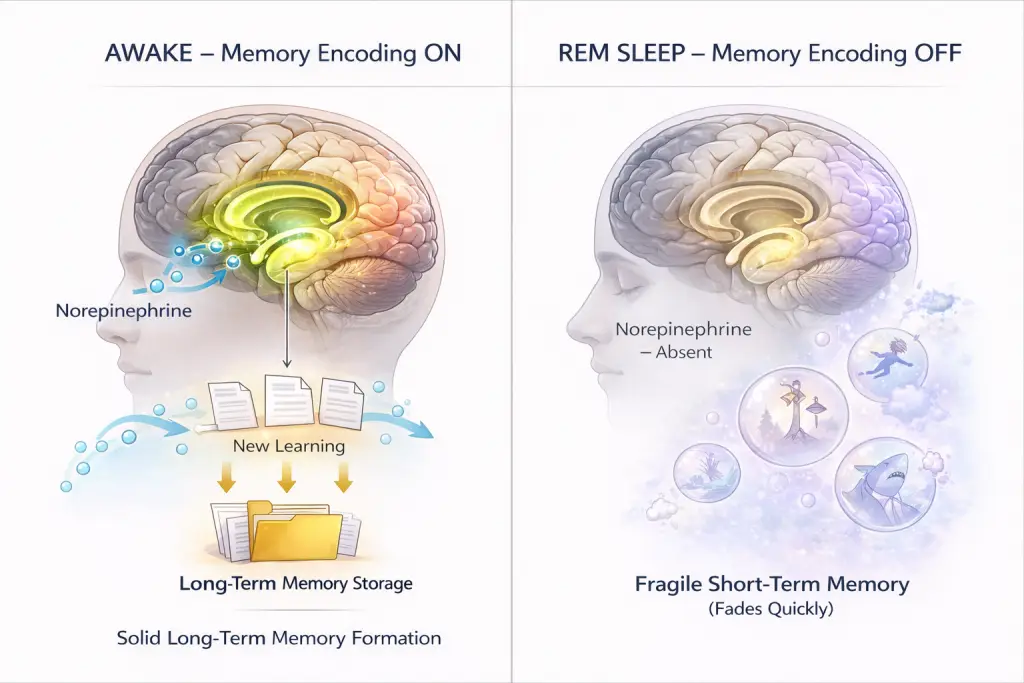
Dream amnesia results from how memory formation works during sleep. The neurochemical environment during REM sleep differs significantly from waking consciousness. Norepinephrine, a neurotransmitter crucial for encoding new memories into long-term storage, is essentially shut off during REM sleep. Your brain can generate experiences but lacks the chemical machinery to transfer them efficiently into lasting memory.
Additionally, the hippocampus—critical for forming new memories—shows different activity patterns during sleep than waking. While it’s active during dreams, processing and replaying information, it’s not encoding the dream experience itself the same way it would encode waking experiences. Dreams exist primarily in short-term memory, which is extremely fragile and easily overwritten by new information.
Why Some Dreams Are Remembered
Despite this memory disadvantage, some dreams do make it into long-term storage. The dreams you remember tend to share certain characteristics. Dreams that wake you up—especially those that end naturally right before waking or are interrupted by an alarm—are more likely to be remembered because you’re conscious during the transition when the dream is still in short-term memory.
Emotionally intense dreams, whether frightening nightmares or particularly vivid pleasant dreams, also transfer to long-term memory more successfully. The emotional significance apparently provides enough neurochemical support to overcome the usual memory formation barriers during sleep. This is why you probably remember more nightmares than neutral dreams.
People who wake frequently during the night remember more dreams than sound sleepers, simply because they catch themselves during or immediately after more REM periods. Interestingly, people who tell themselves before sleep that they want to remember their dreams show improved dream recall, suggesting intentional focus can influence how dreams are processed even during sleep.
If you want to remember more dreams, keep a dream journal by your bed and write immediately upon waking, before getting up or checking your phone. Those first minutes are crucial—dream memories fade exponentially fast, but recording them quickly can capture details that would otherwise disappear.
What About Nightmares and Recurring Dreams?
Not all dreams are neutral memory processing or creative problem-solving sessions. Nightmares—frightening dreams that wake you up—and recurring dreams—similar dream themes or scenarios that repeat over time—deserve special attention because they often signal something requiring your attention.
Nightmares are most common in children, with frequency decreasing through adulthood. However, adults experiencing high stress, trauma, anxiety disorders, or certain medications may have frequent nightmares. While occasional bad dreams are completely normal, persistent nightmares can indicate underlying psychological issues that need addressing.
From an evolutionary perspective, nightmares might serve as threat rehearsal. Your brain simulates dangerous scenarios—being chased, falling, losing control—as practice for real threats. The problem is that modern life presents stressors your ancient brain interprets as dangers, leading to nightmares about situations that aren’t actually life-threatening but feel overwhelming.
The Message in Recurring Dreams
Recurring dreams are particularly fascinating. When your brain keeps replaying similar scenarios—showing up unprepared for an exam, losing your teeth, being unable to run or scream—it’s often attempting to process an unresolved issue or recurring stress in your life. The dream repeats because your brain hasn’t successfully processed whatever psychological content it represents.
Research suggests recurring dreams often reflect persistent life stressors or unresolved conflicts. Students frequently dream about missing exams or being unprepared for presentations during high-stress academic periods. People in unsatisfying jobs often have dreams about being trapped or unable to escape. The dreams don’t necessarily predict the future or reveal hidden truths, but they do reflect your brain’s recognition of ongoing psychological challenges.
Interestingly, lucid dreaming—becoming aware you’re dreaming while still asleep—can sometimes help people address recurring nightmares. When you realize you’re dreaming, you can consciously change the dream narrative, potentially giving your brain a different way to process the underlying issue. Some therapists use lucid dreaming training as a tool for treating nightmare disorders.
Lucid Dreams – When You Know You’re Dreaming
Speaking of lucid dreams, this phenomenon deserves deeper exploration. Lucid dreaming occurs when you become consciously aware during a dream that you’re dreaming, sometimes gaining the ability to control or influence the dream narrative. Surveys suggest about 55% of people have experienced at least one lucid dream, while some individuals lucid dream regularly.
During lucid dreams, brain scans reveal a fascinating pattern: most of your brain still shows typical REM sleep activity, but your prefrontal cortex—the logical, self-aware part normally offline during dreams—partially reactivates. This creates a hybrid state where you’re simultaneously dreaming and consciously aware, experiencing the vivid sensory content of dreams while maintaining metacognitive awareness that it’s not real.
Researchers at the Max Planck Institute successfully demonstrated that lucid dreamers could communicate from inside dreams using predetermined eye movement patterns (remember, eye muscles aren’t paralyzed during REM sleep). They had participants signal when they became lucid and then perform specific counting tasks, proving conscious cognition during the dream state. This opened up remarkable research possibilities—scientists could now study consciousness from inside the dream experience itself.
Learning to Lucid Dream
While some people naturally lucid dream frequently, most can learn to increase lucidity through practice. Techniques include reality testing during the day (regularly checking whether you’re dreaming), maintaining dream journals to improve dream recall and awareness, using specific sleep schedule manipulations, and employing mnemonic techniques like telling yourself before sleep “I will recognize I’m dreaming.”
Beyond the obvious appeal of controlling your dreams, lucid dreaming has therapeutic potential. It’s been used to help people overcome recurring nightmares, reduce PTSD symptoms, and practice skills in a safe environment. Athletes have used lucid dreaming to mentally rehearse physical movements. Musicians have composed in lucid dreams. The applications are still being explored, but they suggest consciousness during sleep offers unique cognitive opportunities.
However, lucid dreaming isn’t without potential downsides. Some researchers caution that excessive focus on lucid dreaming might interfere with natural sleep processes that serve important functions. The jury is still out on whether controlled, conscious dreaming provides the same memory consolidation and emotional processing benefits as spontaneous dreams.
Do Dreams Have Meaning?
This brings us to perhaps the most debated question: do dreams actually mean anything, or are they just random neural firing with no significance? The answer lies somewhere between “deeply meaningful messages from your subconscious” and “completely random noise.”
Sigmund Freud famously argued dreams revealed unconscious wishes and repressed desires expressed in symbolic form. While modern neuroscience has moved far beyond Freudian dream interpretation, the core insight that dreams reflect psychological content holds up. Your dreams aren’t random—they draw from your memories, concerns, emotions, and daily experiences.
However, dreams don’t work through universal symbols. Dreaming about snakes doesn’t necessarily mean anything about sexuality or danger—it might just mean you saw a snake documentary before bed. Dream content is highly personal, drawing from individual experiences, cultural background, and current life circumstances. The meaning, if any, comes from understanding what specific dream elements represent to you, not from consulting a dream dictionary claiming universal interpretations.
The Activation-Synthesis Theory
The activation-synthesis hypothesis, proposed by psychiatrists Allan Hobson and Robert McCarley, suggests dreams result from the brain trying to make sense of random neural activity during REM sleep. The brainstem activates various brain regions randomly, and your cortex attempts to synthesize this scattered activation into a coherent narrative—hence the often bizarre, illogical nature of dreams.
This doesn’t mean dreams are meaningless, though. Even if the initial neural firing is random, the way your brain weaves that activity into narratives reveals what’s psychologically salient. The memories accessed, emotions triggered, and narrative patterns created still reflect your concerns, experiences, and mental state.
Modern understanding integrates multiple perspectives: dreams aren’t prophetic messages or direct translations of unconscious desires, but neither are they meaningless static. They reflect your brain’s ongoing work processing memories, regulating emotions, and maintaining mental health—work that reveals what’s occupying your psychological resources even if it doesn’t translate to simple interpretations.
Dreams Across Different Sleep Disorders
Understanding why we dream also helps explain what goes wrong in various sleep disorders. When the dreaming system malfunctions, it can produce troubling symptoms that disrupt both sleep quality and waking life.
In narcolepsy, people experience REM sleep intrusions into waking consciousness—essentially, pieces of dreams bleeding into waking life. This causes hallucinations, sleep paralysis (the REM atonia muscle paralysis occurring while awake), and sudden loss of muscle tone triggered by emotions. The normal boundaries between dreaming and waking break down, demonstrating how crucial proper sleep stage regulation is for normal functioning.
REM sleep behavior disorder, mentioned earlier, involves the failure of muscle paralysis during REM sleep. People physically act out their dreams, sometimes violently, potentially injuring themselves or bed partners. This condition, more common in older adults especially those with Parkinson’s disease, reveals how important the protective paralysis mechanism is during our most vivid dreams.
Sleep Paralysis – The Waking Nightmare
Sleep paralysis is a particularly unsettling experience where you wake up but remain temporarily paralyzed—still caught in REM atonia. This often comes with intense hallucinations, typically of menacing presences or pressure on your chest. Cultures worldwide have folklore about demons or spirits that sit on sleeping people’s chests—likely cultural interpretations of universal sleep paralysis experiences.
Sleep paralysis results from waking during REM sleep before the muscle atonia releases. Your conscious mind is awake but your body hasn’t received the signal to restore muscle control. The hallucinations occur because parts of your brain are still in dream mode while you’re consciously aware. Understanding this phenomenon doesn’t make it less frightening when it happens, but it does explain why it occurs and reassures people it’s not dangerous—the paralysis ends within seconds to minutes as brain systems fully transition to waking state.
These disorders highlight that dreaming isn’t just an interesting curiosity—it’s a fundamental brain function with specific neurological mechanisms that can malfunction with serious consequences for quality of life.
The Future of Dream Research
Dream science stands at an exciting frontier. New technologies allow researchers to peer into the sleeping brain with unprecedented detail, and some emerging research sounds like science fiction.
Scientists at ATR Computational Neuroscience Laboratories in Japan have used fMRI brain scans and machine learning to partially decode dream content. Participants were woken during early sleep stages, reported what they dreamed about, and researchers correlated brain activity patterns with specific dream elements. The algorithm could predict with some accuracy whether a person had dreamed about specific objects, people, or scenarios based on brain scans alone.
This “dream reading” technology is primitive but represents a remarkable proof of concept—mental experiences during sleep create measurable brain patterns that correlate with specific content. Future developments might allow more detailed dream decoding, though ethical questions about privacy and consciousness make this technology both fascinating and unsettling.
Potential Applications
Beyond satisfying curiosity about what dreams look like from outside, understanding dreams better has practical applications. Improved understanding of dream mechanisms could lead to:
Better treatments for PTSD and anxiety disorders that disrupt sleep and cause nightmares. Targeted therapies could help restore healthy dream function, improving emotional processing.
Enhanced learning techniques that leverage sleep-dependent memory consolidation. If we understand exactly how dreams contribute to memory formation, we might develop methods to optimize learning through strategic sleep timing and conditions.
New approaches to creativity and problem-solving that harness the brain’s hyperassociative dream state. Understanding how dreams facilitate creative thinking could inform innovation strategies.
Insights into consciousness itself. Dreams represent a unique state where you’re conscious yet disconnected from external reality—studying this might reveal fundamental principles about how consciousness emerges from brain activity.
Conclusion – The Essential Mystery of Dreams
So why do we dream? The most honest answer is: for multiple reasons, and we’re still figuring them all out. Dreams aren’t a single phenomenon with a single purpose—they’re a complex state where your brain consolidates memories, processes emotions, solves problems, and perhaps does housekeeping that maintains cognitive health. They’re simultaneously biological necessity and window into consciousness.
What’s remarkable is that every night, without any conscious effort, your brain generates entire worlds, complex narratives, vivid sensory experiences, and emotional journeys. You live alternative realities for hours, experiencing events that never happened but that feel completely real in the moment. Dreams reveal the extraordinary creative power of your brain—its ability to generate richly detailed experiences entirely from internal resources.
The fact that we still don’t completely understand why we dream, despite dreaming being universal across humans and common across mammals, highlights how much mystery remains about consciousness itself. Every night, you enter an altered state of consciousness that’s fundamentally different from waking life yet somehow continuous with it. Your dreams draw from your memories and concerns yet surprise you with their creativity. They’re simultaneously you and not-you—generated by your brain yet largely outside conscious control.
Perhaps the most important takeaway is practical: dreams matter. They’re not just meaningless mental noise or entertainment for your sleeping hours. They serve essential functions for memory, emotion, creativity, and mental health. Protecting your sleep—getting enough hours, maintaining consistent schedules, creating conditions for quality rest—isn’t just about feeling refreshed. It’s about giving your brain the time it needs to do the crucial work that happens during dreams.
The next time you wake from a vivid dream, take a moment to appreciate the extraordinary phenomenon you just experienced. Your brain just took you on a journey through a world that exists nowhere but in neural patterns—yet felt completely real while it lasted. That’s the daily miracle of dreaming, and it’s why we’ll likely continue being fascinated by dreams for generations to come.
Discover more from Factopiax
Subscribe to get the latest posts sent to your email.