

Every year, millions of people stare up at the Great Pyramid of Giza and ask the same question: how did ancient Egyptians build the pyramids without cranes, computers, or modern machinery? It sounds almost impossible. Yet there it stands — 481 feet tall, made from roughly 2.3 million limestone blocks, each averaging 2.5 tons. And it has stood that way for over 4,500 years.
For decades, answers ranged from the sensible to the spectacular. Some people pointed to ramps. Others insisted on alien intervention. But 2025 and 2026 have delivered some of the most compelling archaeological evidence yet — from hidden chambers inside the Menkaure Pyramid to a newly discovered 30-meter corridor inside Khufu’s Great Pyramid, and ancient papyrus work logs written by a real man who helped build it. Science is closing in on the full picture. By the time you finish reading this, the mystery will feel a lot less mysterious — and a lot more extraordinary.
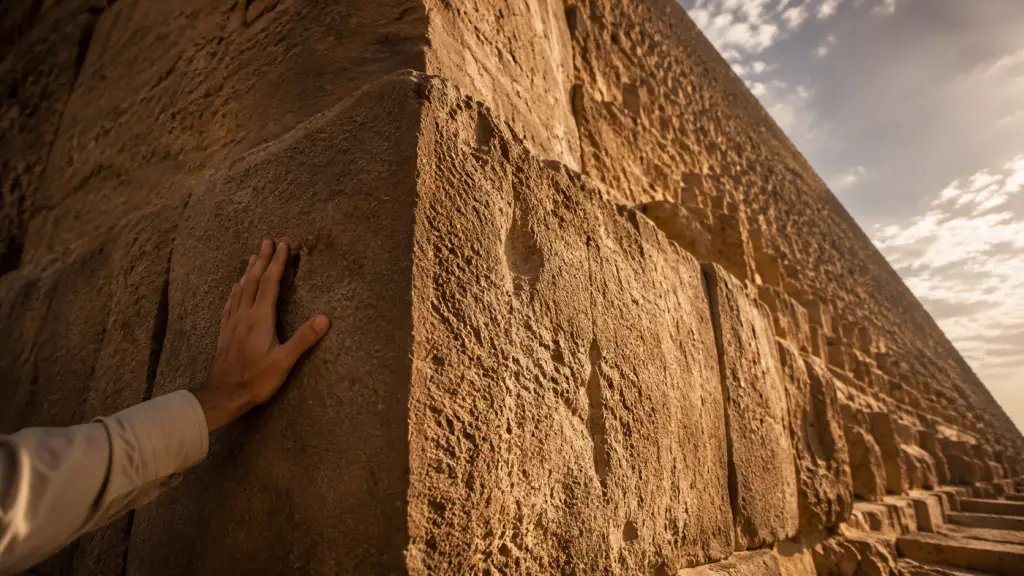
with sub-millimetre precision.
The Scale of the Challenge: What We’re Actually Talking About
Before we get into the how, spend a moment thinking about the what.
The Great Pyramid of Khufu at Giza contains roughly 2.3 million stone blocks. The average block weighs around 2.5 tons — the equivalent of a large pickup truck. The heaviest granite slabs used in the King’s Chamber weigh up to 80 tons each. Builders placed these stones with such precision that the gaps between them are less than half a millimeter wide. Many modern buildings can’t match that accuracy.
The structure covers 13 acres at its base and was originally clad in gleaming white Tura limestone casing stones, which would have caught the desert sun and been visible for miles. It remained the tallest man-made structure on Earth for more than 3,800 years.
And all of this happened around 2560 BCE — well before the wheel was widely used in Egypt, before iron tools existed, and before written mathematics as we understand it was formalized anywhere in the world.
So the scale of the challenge isn’t just impressive. It’s genuinely staggering. Even engineers today, given the materials available at the time, struggle to explain exactly how everything came together. But here’s what we do know: it was done by human hands, with human ingenuity, and we have the receipts to prove it.
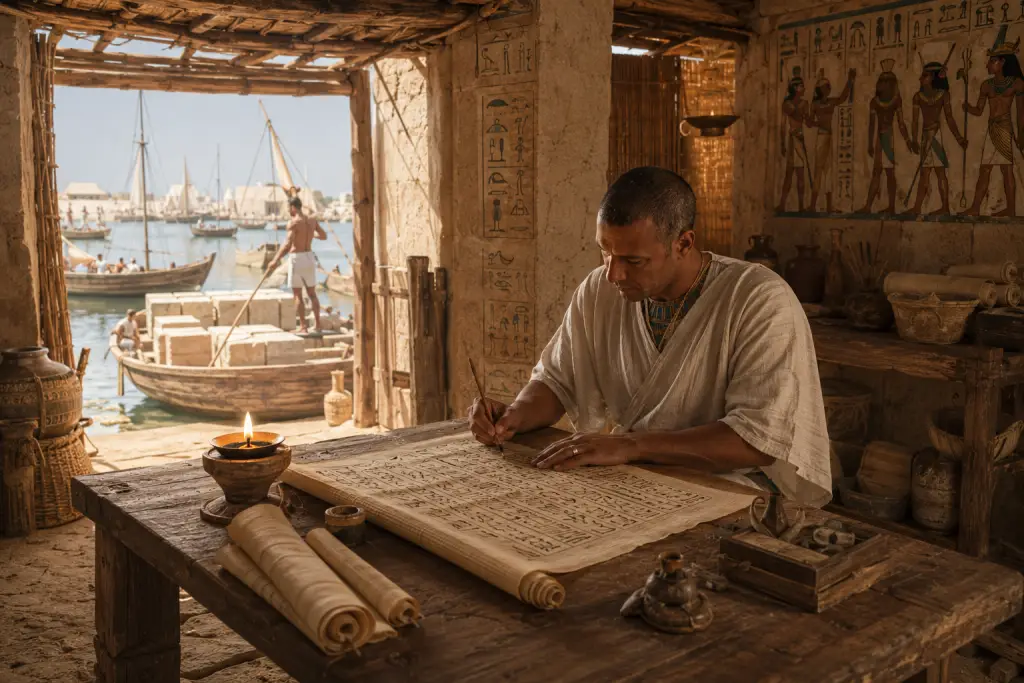
in Egypt — and it describes building the Great Pyramid in real time.
Debunking the Alien Theories — Once and for All
Let’s address the elephant in the room. Or, more accurately, the extraterrestrial.
Popular culture still promotes the alien pyramid theory. Aliens built the pyramids or helped humans. Experts thoroughly debunked this myth. Egyptologist Zahi Hawass rejects alien involvement directly. He states no extraterrestrial beings or supernatural forces helped.That assessment isn’t a matter of opinion. It’s backed by mountains of archaeological evidence. The Jerusalem Post
Think about what the alien theory actually requires you to believe. You’d need to accept that beings capable of interstellar travel — crossing light-years of space — arrived on Earth, and then chose to move rocks using methods that left no technological signature whatsoever. No unusual metal alloys. Absolute Zero energy sources. No anomalous materials. Nothing that breaks from what 4th Dynasty Egypt could produce.
Using evidence from quarries, workers’ villages, and logistics records, Hawass has shown how Old Kingdom engineers transported and placed limestone and granite blocks without modern machinery. All of it fits neatly within the known capabilities of ancient Egyptian civilization. Furthermore, we have graffiti left by the workers themselves — team names like “Friends of Khufu” and “Drunkards of Menkaure” spray-painted in red ochre inside the relieving chambers above the King’s Chamber. Aliens do not leave team nicknames. The Jerusalem Post
The real explanation is both more grounded and, if you think about it, far more impressive. Humans did this. And that’s exactly why it still blows our minds.
The Workforce Reality: Paid Workers, Not Slaves
One of the most enduring myths about how ancient Egyptians built the pyramids is that they used enslaved people. Hollywood cemented this idea for generations. The truth, however, is almost the opposite.
Excavations at Heit el-Ghurab revealed a state-supported labor force. People call it the Giza Workers’ Village. The state fed these workers well. Officials provided them medical care. Workers received proper burials. This settlement, located just southeast of the pyramids, was first uncovered in 1988 by American archaeologist Mark Lehner. Radiocarbon dating confirmed that it was active during the reigns of Khufu, Khafre, and Menkaure — corresponding directly to the main phase of pyramid construction at Giza. Egypt Tours PortalEgypt Tours Portal
Bakeries at the site produced thousands of loaves of bread, alongside beer, to provide workers with the energy needed for construction. There was clear administrative organization, with workers divided into teams supervised by engineers and overseers responsible for implementing construction plans. Bones recovered from the workers’ cemetery show evidence of healed fractures — meaning the state provided medical care significant enough that people survived serious injuries. EgyptaTours
Then there’s the papyrus evidence. In 2013, at a site called Wadi el-Jarf on Egypt’s Red Sea coast, archaeologists Pierre Tallet and Gregory Marouard discovered entire rolls of papyrus — the oldest ever found in Egypt. Some of them were books of accounts detailing the movement of bread, beer, cereals, and meat to feed the 20,000-strong workforce spread across the pyramid site, quarries, and transport teams. Amusing Planet
This wasn’t a slave operation. It was a logistical marvel, run like a modern construction project — with payroll, food supply chains, and healthcare.
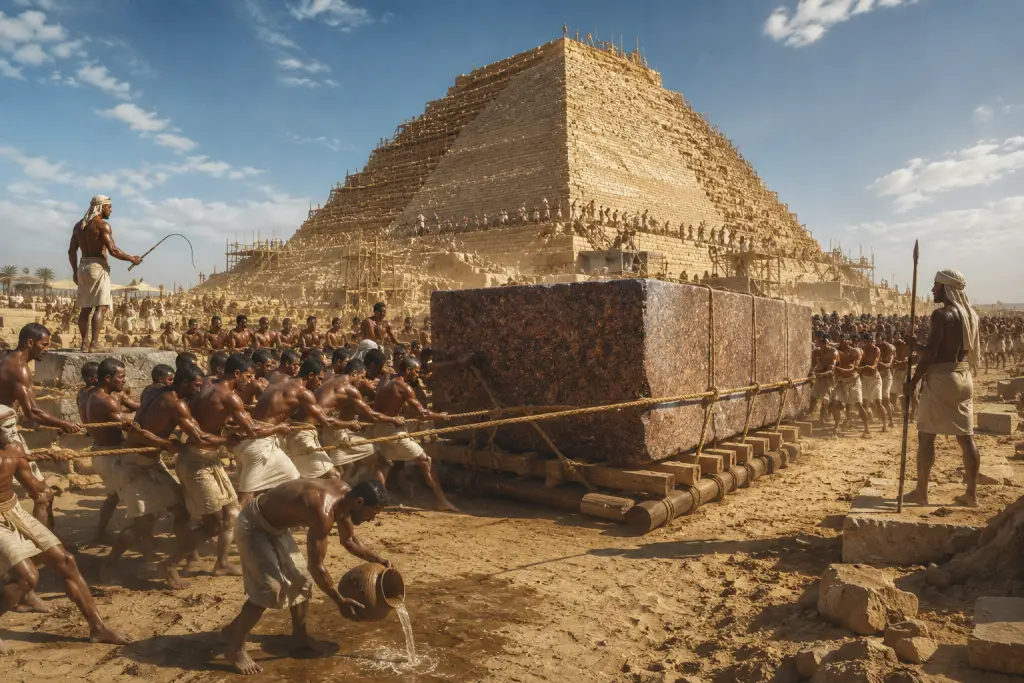
Egyptian tomb murals and confirmed by modern physics experiments.
The Diary of Merer: An Ancient Construction Log That Changes Everything
Here’s where the evidence gets genuinely remarkable. Buried inside those papyrus rolls found at Wadi el-Jarf was a personal work diary. It belonged to a man named Merer.
Merer wrote the hieroglyphic logbook over 4,500 years ago. This middle-ranking inspector detailed Great Pyramid construction. He recorded work at the Tura limestone quarries. These quarries lay across the Nile River. Merer documented these operations for several months. HISTORY
The best-preserved sections document the transportation of white limestone blocks from the Tura quarries to Giza by boat. Merer’s team would load the blocks onto barges, sail them along the Nile, and deliver them to the Giza construction site. He recorded this in a timetable format — two columns per day — logging departures, arrivals, crew activities, and supplies. Wikipedia
The logbook was written by an inspector in charge of a team of about 200 men, dated to approximately the 27th year of the reign of Pharaoh Khufu. This makes Merer’s diary the oldest papyrus document ever discovered in Egypt. It’s an eyewitness account of the pyramid being built — written while it was still under construction. Facts and Details
Merer’s detailed records demonstrate that those who built the pyramids were skilled workers who received compensation for their services. The document doesn’t read like the account of a slave driver. It reads like a project manager’s weekly report — precise, professional, and proud. National Geographic
This single discovery settled centuries of speculation. How did ancient Egyptians build the pyramids? With extraordinary organization, skilled labor, and obsessive record-keeping. Just like any major engineering project today — except 4,500 years earlier.
Engineering Techniques: Ramps, Wet Sand, and a New 2026 Theory
So the workforce is accounted for. But how did they actually move and stack millions of stone blocks to heights of nearly 150 meters?
The Ramp Theories
Researchers have long proposed that ancient builders used massive construction ramps to haul blocks up the pyramid’s growing face. The problem with a simple external ramp is mathematics. Builders needed a manageable pulling gradient. A ramp to the pyramid’s top would stretch one mile long. It would require more material than the pyramid itself. Workers would dismantle the ramp completely afterward. This process would leave no trace.
An alternative, the internal spiral ramp theory proposed by French architect Jean-Pierre Houdin, suggests builders used a concealed ramp spiraling inside the pyramid’s outer shell. Infrared scanning of the Great Pyramid has revealed thermal anomalies consistent with this internal structure. Scanning technologies have uncovered a previously unknown 30-meter corridor inside Khufu’s pyramid, and robots have reached and cleaned openings once out of human reach. This corridor’s existence lends credibility to the internal ramp hypothesis — and its contents remain undisclosed until a planned 2026 reveal. The Jerusalem Post
Wet Sand: A Proven Physics Trick
A famous experiment published by Dutch researchers demonstrated that ancient Egyptians almost certainly wet the sand in front of sledges carrying heavy stone blocks. Murals at the tomb of Djehutihotep — an Egyptian nobleman — actually depict this exact technique, showing a man pouring liquid at the front of a loaded sled. Laboratory testing confirmed that just the right amount of water reduces sand friction by roughly half, making massive blocks surprisingly manageable to pull.
The 2026 Counterweight Theory
Dr. Simon Andreas Scheuring proposed this idea in early 2026. He works at Weill Cornell Medicine. Ancient Egyptians used networks of counterweights and pulley-like devices. They raised the monuments with these systems inside. His calculations indicate that workers could have positioned enormous stone blocks at extraordinary rates — potentially as fast as one block every minute. He points to the Grand Gallery — long assumed to be a ceremonial walkway — as a functional lifting machine. Grooves carved into the granite walls and stone supports which may have held wooden beams suggest the chamber operated as functional machinery. Scratches, wear marks, and polished surfaces along the Grand Gallery’s walls point to large sledges moving repeatedly through the space. GB NewsGB News
Egyptologists still evaluate this theory. However, if it holds, it would explain one of the biggest remaining puzzles: how builders maintained construction speed at elevation.
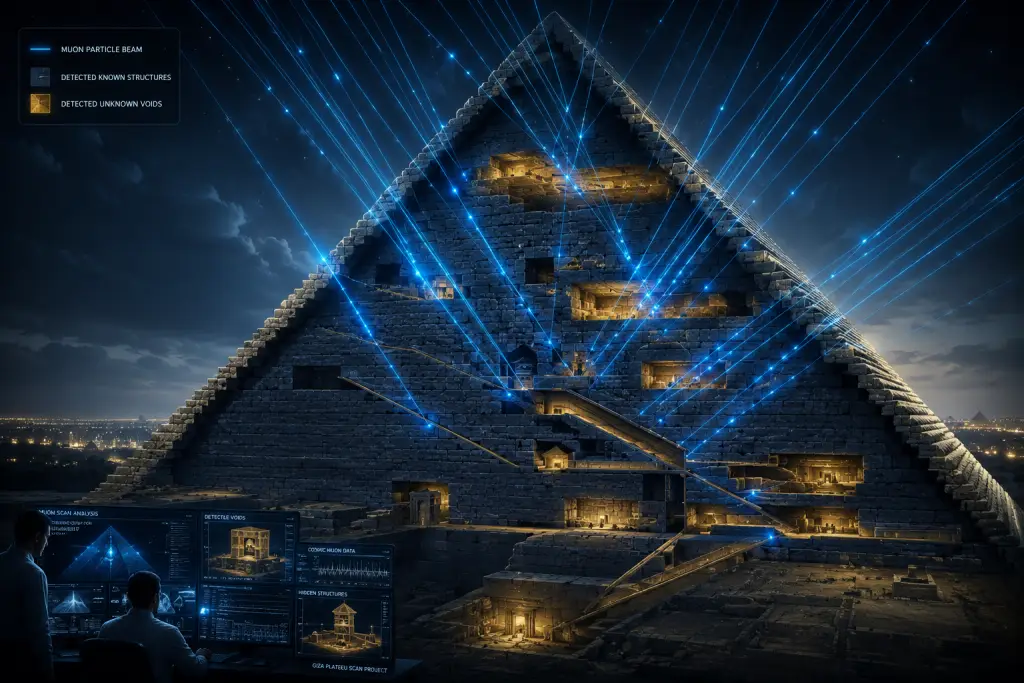
Egypt’s pyramids that human eyes have never seen — without a single scratch to the stone.
Tool Technology: Copper, Dolerite, and Ancient Precision
You might assume that building the pyramids required advanced metallurgy. In fact, the tools available to ancient Egyptian builders were simpler than most people expect — yet deployed with extraordinary skill.
Copper was the primary metal of the era. Workers used copper chisels and saws to cut and shape limestone blocks. Copper is softer than the stone it cut, so tools needed constant resharpening and replacement. Archaeologists have found large quantities of copper debris around pyramid construction sites — evidence of intense, sustained toolmaking operations.
For the hardest granite, builders used dolerite pounders — rounded balls of an igneous rock harder than granite itself. Workers would pound these balls against granite surfaces repeatedly, wearing them down over time rather than cutting them cleanly. It was slow, grinding, physical work. But it produced results precise enough to seal sarcophagus lids with barely a hair’s width of gap.
Lever systems, made from wooden beams and stone pivot points, allowed small teams to tilt and reposition heavy blocks with far less effort than brute lifting. Experimental archaeologists have repeatedly demonstrated that a team of 20 to 30 trained workers can move and position a two-ton block using ropes, sledges, and simple levers — no supernatural assistance required.
Researchers published a 2025 study in PLOS ONE. The study proposed a new idea. Builders used a primitive hydraulic system. Channels inside the pyramid carried water.This water powered a lifting mechanism. By combining decades of archaeological records with modern satellite imagery, researchers identified a network of trenches carved into the pyramid’s structure, and proposed that water pressure may have functioned to push stone blocks upward through a vertical shaft. If validated, this would mean hydraulic engineering was part of the Egyptian toolkit far earlier than previously imagined. Daily GalaxyFutura-Sciences
What 2025 and 2026 Scans Are Revealing Right Now
This story is not just ancient history. It is actively being rewritten.
Researchers from Cairo University and the Technical University of Munich have discovered two previously unknown air-filled cavities in the Menkaure Pyramid at Giza, the smallest of the three great pyramids. Their findings, part of the ongoing ScanPyramids project, were published in NDT & E International and support a long-standing hypothesis that a second entrance may exist on the eastern side of the monument. Archaeology News
Using georadar, ultrasound, and electrical resistivity tomography, the researchers scanned the eastern façade of the Menkaure Pyramid and identified two distinct air-filled voids located just behind a mysteriously polished section of granite — an area that had puzzled Egyptologists for decades. “After the significant discovery of an unknown chamber in the Pyramid of Khufu in 2023, ScanPyramids has once again succeeded in making an important discovery in Giza,” said Christian Grosse, a professor of non-destructive testing at the Technical University of Munich. Science News TodayNewsweek
Meanwhile, inside Khufu’s Great Pyramid itself, the picture is equally tantalising. Using muon radiography, thermal imaging, and 3D ground-penetrating radar, the ScanPyramids team identified a significant density change behind the pyramid’s North Face. Initial data suggests a 30-meter corridor is horizontal and located just above the main entrance area. Zahi Hawass has teased the robots to reach and clean openings inside this corridor, and that its contents will be unveiled in 2026 as what he calls “a great archaeological discovery that will write a new chapter in the history of the pharaohs.” Ancient OriginsThe Jerusalem Post
That announcement hasn’t landed yet. But when it does, it will likely land loudly.

The Organizational Genius Behind It All
Engineering techniques and clever tools only tell part of the story. The truly staggering achievement of the ancient Egyptians wasn’t just physical — it was administrative.
Think about the coordination involved. Stone was quarried at multiple sites across Egypt. Tura limestone came from the opposite bank of the Nile. Granite for the King’s Chamber was quarried as far away as Aswan and transported to Giza by boat during the Nile’s seasonal floods. Merer’s papyrus shows that different crews operated simultaneously across quarries, river routes, and the construction site itself — all coordinated by a bureaucratic system sophisticated enough to log daily activities in formal records. Facts and Details
The Wadi el-Jarf site reveals that the harbor was a sprawling enterprise where hundreds of workers supported mining operations in the Sinai. The workers were then organized into groups, and ensured the site functioned smoothly. These weren’t random laborers. They were career specialists, organized into named crews, supervised by inspectors, and paid in food, clothing, and supplies by the state. Archaeology Magazine
Archaeological graffiti found inside the relieving chambers above the King’s Chamber gives us crew names. “Friends of Khufu.” “The Followers of Khufu.” These workers had identities, group pride, and apparently competitive spirits. Construction of the pyramids wasn’t a death march, but was a national project with cultural prestige attached.
Add to that the sheer planning precision: the pyramid’s base is level to within 2.1 centimeters across its entire 230-meter span, and its four sides are oriented to the cardinal directions with an accuracy of within 0.05 degrees. That level of surveying and planning, without modern instruments, speaks to a mathematical and organizational sophistication that still earns the respect of modern engineers.
Frequently Asked Questions
How did ancient Egyptians build pyramids without modern tools?
Ancient Egyptians built the pyramids using copper chisels, dolerite pounders, wooden sledges, levers, and rope — combined with an enormous, well-organized workforce. Wet sand dramatically reduced friction for hauling blocks. Boats transported stone from distant quarries via the Nile. The key wasn’t any single miraculous technique but rather extraordinary organizational planning and sustained, skilled human effort over roughly 20 years.
Did slaves build the Egyptian pyramids?
No. Archaeological evidence from the workers’ village at Heit el-Ghurab, along with the Merer papyri discovered in 2013, confirms that pyramid builders were paid workers — skilled laborers who received food, medical care, and proper burials from the Egyptian state. The slave narrative originated largely with ancient Greek historians and has been definitively refuted by modern archaeology.
What new discoveries are made about ancient Egyptians building pyramids?
In 2025, ScanPyramids researchers discovered two hidden air-filled cavities inside the Menkaure Pyramid using georadar and electrical resistivity tomography. A 30-meter corridor was also confirmed inside Khufu’s Great Pyramid using muon radiography. In 2026, a theory published by Dr. Simon Scheuring proposes that the Grand Gallery functioned as a counterweight-and-pulley lifting system, potentially placing blocks at a rate of one per minute.
How long did it take to build the Great Pyramid?
Most Egyptologists estimate the Great Pyramid of Khufu took approximately 20 years to complete, during Khufu’s reign around 2560 BCE. To achieve this, workers would have needed to place, on average, around 800 tons of stone per day — or roughly one block every two to three minutes during active construction phases.
What is the ScanPyramids project?
The ScanPyramids project, (October 2015), is an international mission coordinated by Cairo University and the HIP Institute in Paris. It combines non-invasive techniques including infrared thermography, muon tomography, and 3D simulation to map the internal structures of ancient Egyptian pyramids without causing any damage to the monuments. It has already confirmed multiple previously unknown voids inside Khufu’s Great Pyramid and is actively scanning others. Wikipedia
Conclusion
The question of how ancient Egyptians built the pyramids is one humanity has been asking for thousands of years. And yet the honest answer grows more detailed, more scientific, and more impressive with each passing decade.
We now know they were all skilled and paid workers — not slaves — living in a purpose. They built village, ate well, received medical care, and documented their work in papyrus journals. We know they used an arsenal of clever techniques: wet sand, copper tools, wooden sledges, counterweights, and quite possibly hydraulic systems that predate our understanding of that technology by millennia. And thanks to muon scanners, ground-penetrating radar, and robot explorers, we know the pyramids still hold secrets — hidden corridors, unknown chambers, and architectural features that 4,500 years of erosion haven’t managed to erase.
The real answer to this ancient mystery isn’t magical. It’s human. And that’s what makes it extraordinary.
If this story fascinated you, there’s plenty more where it came from. Explore more ancient mysteries and scientific discoveries right here at FactoPiaX — and subscribe to the FactoPiaX YouTube channel for more deep dives into the world’s most gripping untold stories.
Discover more from Factopiax
Subscribe to get the latest posts sent to your email.