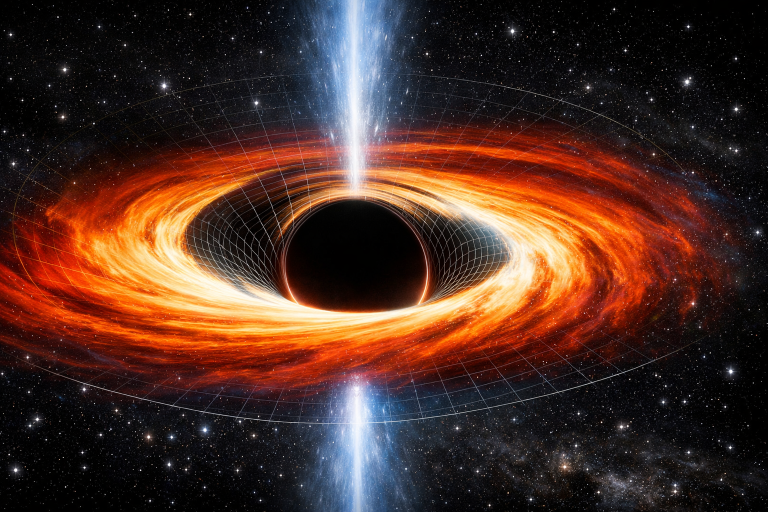

What is dark energy — and why does the universe keep speeding up? That question has haunted physicists since the late 1990s, when a group of astronomers set out to measure how fast the universe was slowing down and came back with an answer that stunned the entire scientific world. It wasn’t slowing down at all. It was accelerating. Something invisible, something we still cannot directly detect, was pushing everything apart at an ever-increasing pace. Scientists named it dark energy — and it turns out to account for roughly 68% of everything that exists.
This post will walk you through how we discovered it, what it actually is, how researchers study something completely invisible, and why a landmark 2025 finding may have just rewritten everything we thought we knew.
The Discovery That Changed Cosmology Forever
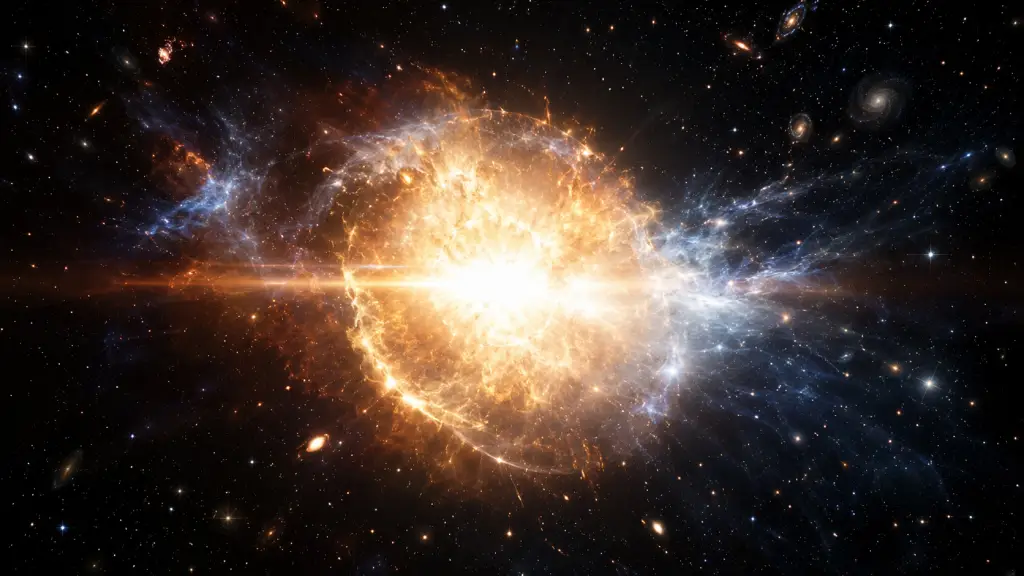
In the 1990s, two independent teams of astronomers had a simple goal. They wanted to measure how much the universe was decelerating. Everyone expected it to be slowing down. Gravity pulls matter together, after all. The Big Bang had sent everything flying outward, but gravity was supposed to be putting the brakes on.
Both teams used a special type of exploding star called a Type Ia supernova. These explosions are incredibly consistent — almost like standard light bulbs scattered across the cosmos. Because scientists know how bright they should be, they can calculate exactly how far away each one is. The dimmer the supernova appears, the farther away it is.
However, something was wrong. The distant supernovae were dimmer than expected. Not by a little — by a measurable, consistent margin. That meant they were farther away than they should have been, given the expected rate of deceleration. In fact, the universe wasn’t decelerating. It was accelerating. The teams published their findings in 1998. The discovery earned Saul Perlmutter, Brian Schmidt, and Adam Riess the Nobel Prize in Physics in 2011.
It was one of the most shocking reversals in the history of modern science. And it introduced a question that scientists are still racing to answer today.
What Dark Energy Actually Is — And What It Isn’t
Here is the honest answer: nobody knows exactly what dark energy is. That might be unsatisfying, but it is also one of the most exciting frontiers in physics right now.
What scientists do know is what dark energy does. It acts like a kind of pressure built into space itself — a repulsive force that counteracts gravity on the largest scales. Unlike gravity, which weakens with distance, this pressure appears to be uniform across the universe. It doesn’t cluster around galaxies. And doesn’t radiate. It has no charge, no detectable particle, and no direct interaction with light.
The most widely used explanation comes from Einstein’s general relativity. When Einstein developed his equations, he added a term called the cosmological constant — represented by the Greek letter lambda (Λ) — to keep the universe static, because he believed the universe was neither expanding nor contracting. He later called it his “greatest blunder” after Edwin Hubble showed the universe was expanding. But after 1998, the cosmological constant came roaring back as the leading candidate for what dark energy might be.
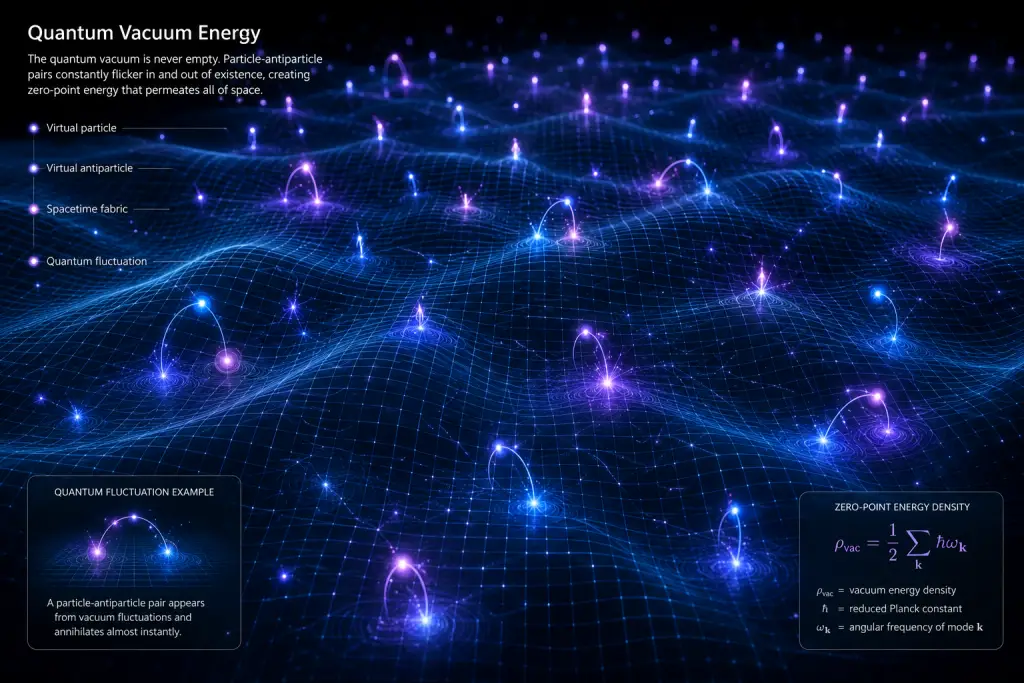
In this model, dark energy is simply the energy of empty space — vacuum energy, sometimes called zero-point energy. Even a perfect vacuum contains quantum fluctuations, tiny flickers of particles appearing and disappearing constantly. The cumulative energy of those fluctuations across all of space could produce exactly the kind of outward pressure we observe.
The problem? When physicists calculate how much energy the vacuum should contain, the number they get is off by a factor of around 10 to the power of 120 compared to what observations suggest. That is not a rounding error. It is, by most accounts, the worst prediction in the history of physics. Something in our understanding is clearly missing.
Could It Be Something Else Entirely?
Some physicists argue dark energy is not a property of space at all. Instead, they propose it could be a dynamic field — something called quintessence — that has its own density and evolves over time. Unlike the cosmological constant, quintessence could change in strength as the universe ages. This distinction matters enormously, as we will see when we get to the 2025 DESI results.
Other proposals include modifications to general relativity itself, suggesting Einstein’s equations may need updating at cosmic scales. Each idea comes with its own predictions, and each one is actively being tested.
The 68% Problem: Most of the Universe Is Dark Energy
Stop and think about this for a moment. Dark energy accounts for roughly 68% of the total energy content of the observable universe, according to NASA’s current cosmological measurements. Dark matter — another invisible substance we cannot directly detect — makes up about 27%. Ordinary matter, meaning everything you have ever seen, touched, or measured, accounts for just under 5%.
In other words, science’s most powerful instruments and equations describe less than 5% of what the universe actually contains. The rest is a placeholder we label “dark” because we genuinely cannot see it.
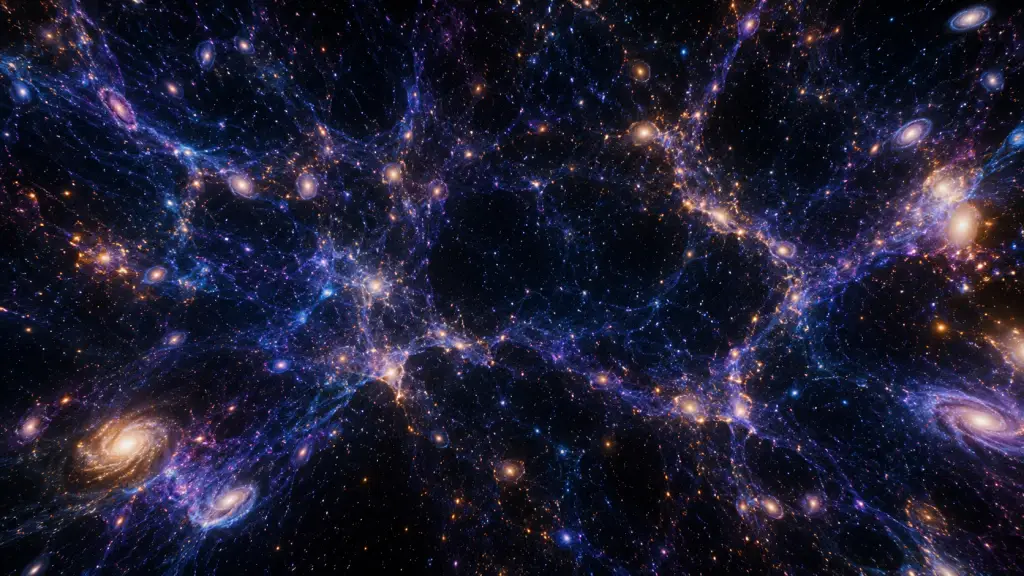
Dark energy does not cluster or clump. It permeates all of space equally — including the space inside galaxies, inside your body, inside every atom. The reason it doesn’t tear you apart is that on small scales, the other fundamental forces are vastly stronger. Gravity, electromagnetism, and the nuclear forces hold matter together far more powerfully than the gentle outward push of dark energy can overcome. But on scales of hundreds of millions of light-years — the scale of galaxy clusters and cosmic filaments — dark energy dominates everything.
That dominance is growing. Because dark energy appears to remain constant as space expands (while matter becomes more diluted), its influence relative to matter keeps increasing. The more the universe expands, the more dark energy gains the upper hand. This is why the expansion keeps accelerating, rather than settling into a steady rate.
How Scientists Study Something They Cannot See
You cannot point a telescope at dark energy. You cannot weigh it or run it through a particle accelerator. So how do scientists actually study it?
The answer lies in measuring its effects on things we can observe.
Supernovae as Cosmic Rulers
The same Type Ia supernovae that led to dark energy’s discovery remain one of the primary tools for measuring it today. By plotting how the expansion rate has changed over billions of years — using supernovae at different distances as historical snapshots — cosmologists can reconstruct the universe’s expansion history. The shape of that history tells you a great deal about what is driving it.
Gravitational Lensing
Massive objects bend light. When light from a distant galaxy passes a cluster of matter on its way to Earth, the cluster acts like a lens — distorting, magnifying, or splitting the image. Scientists study these distortions to map the distribution of matter across the universe. Because dark energy affects how matter clusters together, gravitational lensing patterns carry its fingerprints.
The Cosmic Microwave Background
The CMB — the faint afterglow of the Big Bang — encodes detailed information about the early universe. By comparing those early conditions to what we observe today, scientists can extract measurements of dark energy’s magnitude and behavior. Instruments like the Planck satellite have used CMB data to pin down dark energy’s contribution to extraordinary precision.
Baryon Acoustic Oscillations
Early in the universe’s history, sound waves propagated through the hot plasma that filled space. When the universe cooled enough for atoms to form, those waves froze in place — leaving a characteristic scale in the distribution of galaxies that astronomers can measure today. This “ruler” in the galaxy distribution acts as another tool to track the expansion history and constrain dark energy.
The 2025 Game-Changer: Is What Is Dark Energy Actually Changing?
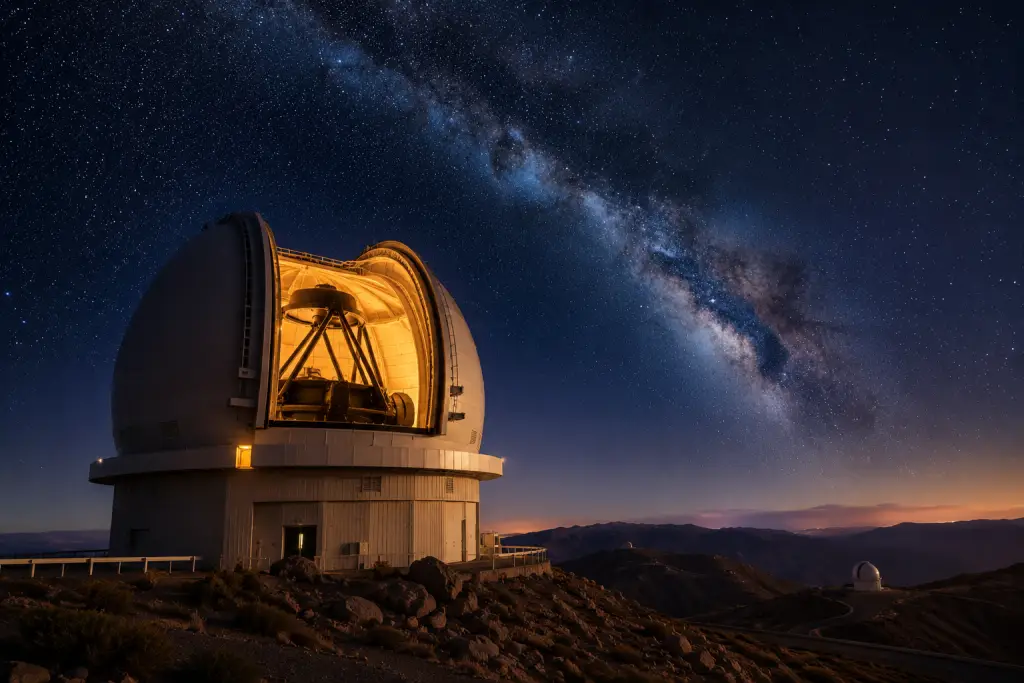
In April 2025, the Dark Energy Spectroscopic Instrument — better known as DESI — released results that sent ripples through the physics community. DESI is a remarkable instrument, mounted on a telescope at the Kitt Peak National Observatory in Arizona. It maps the three-dimensional positions of galaxies by measuring the spectra of light from tens of millions of them simultaneously. By tracking baryon acoustic oscillations across cosmic time, DESI can measure how the expansion rate has changed over the universe’s 13.8-billion-year history.
The results from DESI’s first three years of data suggest that what is dark energy may not be constant. According to the DESI collaboration’s published findings, the data shows a statistically significant hint — at the 2.8 to 3.9 sigma level depending on the dataset combination — that dark energy’s strength has varied over time. If confirmed, this would rule out the simple cosmological constant model and point toward something more dynamic: a field that evolves, strengthens, or weakens as the universe ages.
This is enormously significant. A constant dark energy is strange enough. A changing dark energy would mean the universe’s future is far less predictable than physicists assumed. It would also mean that Einstein’s cosmological constant is not the right answer — and that an entirely new framework may be needed.
Scientists are appropriately cautious. The results are suggestive, not conclusive. Independent confirmation from other instruments, including the Euclid space telescope launched by the European Space Agency, will be essential. Nevertheless, the DESI data represents the most compelling observational hint yet that dark energy is dynamical in nature.
What This Means for the Universe’s Fate
If dark energy is real — and every observation we have confirms it is — what happens to the universe in the far future? The answer depends heavily on exactly what dark energy turns out to be.
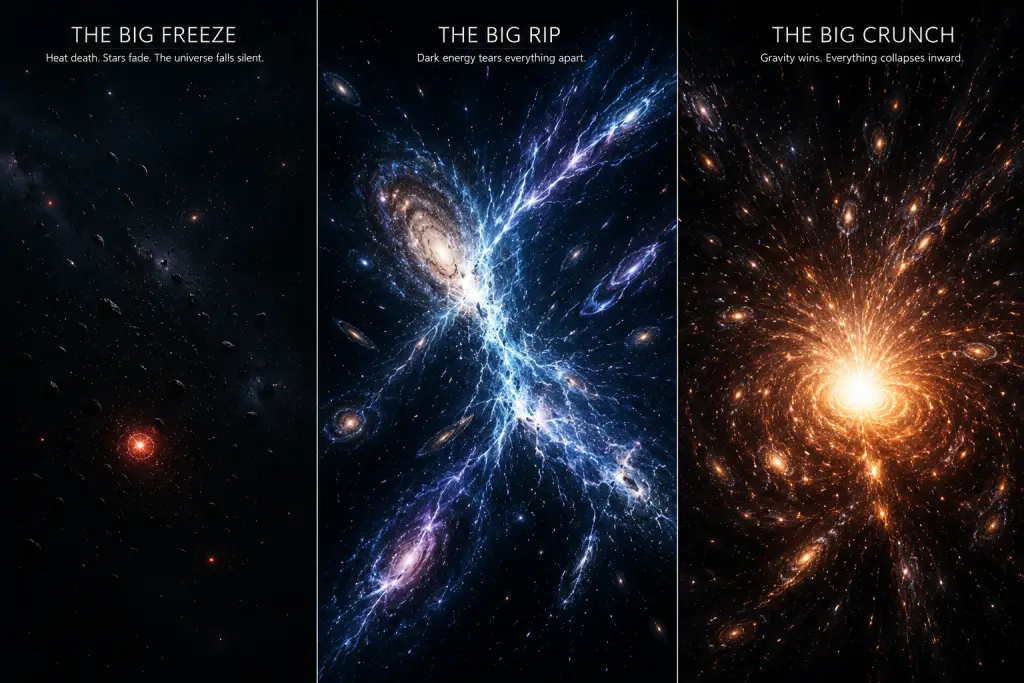
Scenario 1: The Big Freeze
If dark energy remains roughly constant, the universe will keep expanding forever, but at an ever-increasing rate. Over trillions of years, galaxies will drift so far apart that most of the observable universe will become unreachable. Stars will burn out. Black holes will eventually evaporate through Hawking radiation. The universe will settle into a cold, dark, near-empty state of maximum entropy — what physicists call the Big Freeze, or heat death.
Scenario 2: The Big Rip
If dark energy grows stronger over time — which is one interpretation of the DESI results — the expansion could eventually become so rapid that it overpowers all other forces. Gravity would lose the fight. Then the electromagnetic force. Then the nuclear forces holding atoms together. The universe would literally be torn apart at the subatomic level in an event called the Big Rip. Current estimates, if this scenario is correct, place that endpoint tens of billions of years in the future.
Scenario 3: The Big Crunch or Bounce
If dark energy turns out to weaken over time, gravity could eventually win out. The expansion would slow, stop, and reverse — collapsing everything back into an unimaginably dense point. Some theorists propose this could trigger another Big Bang, cycling the universe through endless expansion-contraction phases.
The DESI results make the Big Rip scenario somewhat more plausible than it was before. However, the data does not yet firmly favor any single outcome.
The Race to Understand Dark Energy
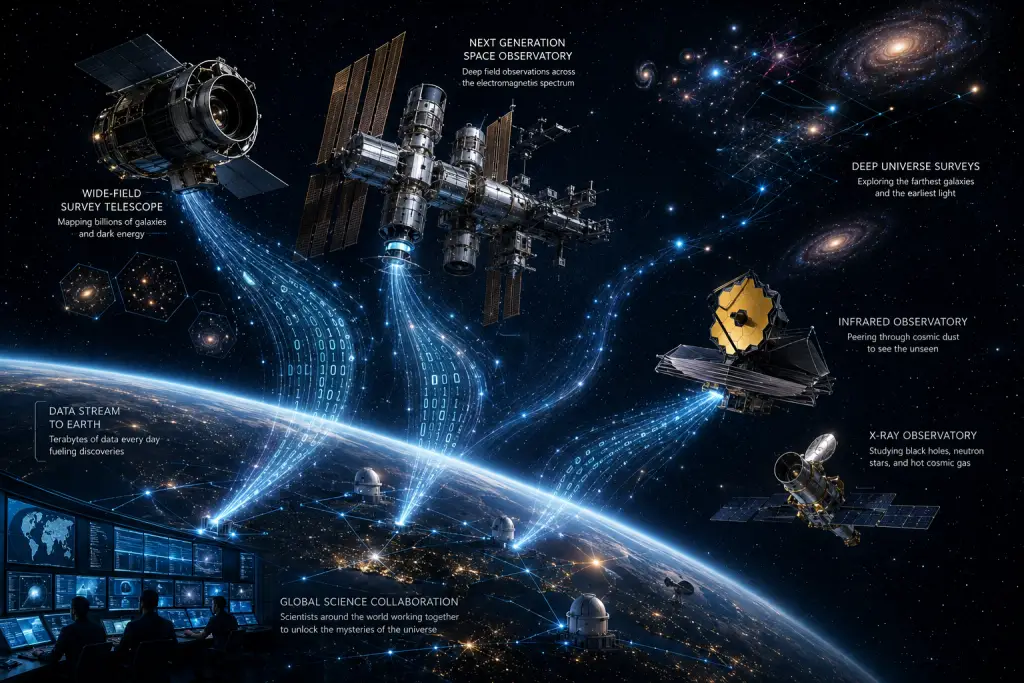
Physicists and cosmologists around the world are pursuing dark energy from multiple directions simultaneously. DESI will continue collecting data through at least 2026, eventually mapping the positions of over 40 million galaxies. The Euclid space telescope, launched by the European Space Agency in 2023, is conducting its own wide-field survey of galaxy shapes and positions across six billion light-years of cosmic history.
NASA’s Nancy Grace Roman Space Telescope, currently scheduled for launch in the late 2020s, will add another layer of precision — surveying billions of galaxies with a wide field of view comparable to Hubble’s but covering far larger areas of sky. Meanwhile, the Vera C. Rubin Observatory in Chile is preparing to conduct the Legacy Survey of Space and Time — a ten-year photometric survey that will catalog tens of billions of objects and provide unprecedented statistical power for dark energy studies.
On the theoretical side, physicists are developing increasingly sophisticated models of quintessence fields, modifications to gravity, and exotic proposals involving extra dimensions or quantum gravity effects. None of these has yet been confirmed, but each makes testable predictions that the next generation of surveys will be able to check.
The convergence of so many high-precision instruments, all pointing at the same fundamental question, is genuinely unprecedented. Whatever dark energy turns out to be, we are closer to finding out than at any point since 1998.
Frequently Asked Questions
Is dark energy the same as dark matter?
No — these are two entirely different things. Dark matter is an invisible form of mass that gravitationally clusters around galaxies and holds them together. Dark energy, by contrast, acts as a repulsive force spread uniformly throughout space, driving galaxies apart. They are both “dark” in the sense that we cannot detect them directly, but they behave in completely opposite ways.
Can we ever directly detect dark energy?
Currently, no instrument can detect dark energy directly. All our knowledge of it comes from observing its gravitational effects on the expansion of the universe and the distribution of matter. However, if dark energy is a dynamical field, it might eventually leave signatures that future instruments could detect through very precise measurements of cosmic structure.
What is dark energy’s connection to the Big Bang?
Dark energy played almost no role in the early universe. In the first billions of years after the Big Bang, matter and radiation dominated, and their gravity was sufficient to slow the expansion. Dark energy only began to dominate when the universe had expanded enough that matter became sufficiently diluted — roughly five to six billion years ago. That is when the expansion began accelerating.
Why does dark energy accelerate the universe’s expansion?
Dark energy behaves like a negative pressure built into the fabric of space. In general relativity, both energy density and pressure contribute to the gravitational field. Ordinary matter has positive pressure, which adds to attraction. Dark energy has negative pressure — so strong that it overwhelms its own energy density’s gravitational effect and produces a net repulsive outcome. The result is accelerated expansion.
How confident are scientists that dark energy actually exists?
Extremely confident in its existence, based on multiple independent lines of evidence: Type Ia supernovae data, the cosmic microwave background, baryon acoustic oscillations, and gravitational lensing all point to the same conclusion. What remains deeply uncertain is its nature — whether it is a fixed cosmological constant, a dynamic field, or something else entirely.
The universe has spent 13.8 billion years expanding, and something invisible has been pushing it along for at least the last six billion of those years. What is dark energy, exactly? We still don’t have the complete answer — and that is precisely what makes it one of the most compelling puzzles in all of science.
The 2025 DESI findings have added a thrilling new dimension. Dark energy might not be the static cosmological constant Einstein proposed. It might be alive, evolving, changing its strength as the cosmos ages. If that is confirmed, physics will need a genuinely new framework — not a tweak, but a revolution.
We are living in a remarkable moment. Instruments of staggering precision are mapping the universe in three dimensions across billions of light-years. Theoretical physicists are pushing the boundaries of what space, time, and energy even mean. And somewhere in that data — in the spectra of tens of millions of galaxies, in the faint glow of the CMB, in the dimness of supernovae billions of light-years away — the answer is hiding.
Stay curious. The universe is stranger and more magnificent than it has any right to be. For more mind-expanding science from the edge of human knowledge, explore FactoPiaX — and check out our YouTube channel at FactoPiaX on YouTube for more on the deepest questions in cosmology.
Discover more from Factopiax
Subscribe to get the latest posts sent to your email.